





![[Multi SUB] 🔥In her previous life, she married a scumbag by mistake, and her whole family was wiped out and died miserably. When she was reborn, the scumbag wanted to marry another princess, but she broke up with her and hooked up with the powerful governor of Yedong Factory. The ruthless governor was willing to risk his life to protect her and help her crush the enemies and ascend to the throne! [My ex-husband gave me away, and I flattered the governor to ascend to the throne]](/uploads/2026/09/10/cryptocurrencies-news/videos/origin_6aa247be8bfd9_image_500_375.webp "[Multi SUB] 🔥In her previous life, she married a scumbag by mistake, and her whole family was wiped out and died miserably. When she was reborn, the scumbag wanted to marry another princess, but she broke up with her and hooked up with the powerful governor of Yedong Factory. The ruthless governor was willing to risk his life to protect her and help her crush the enemies and ascend to the throne! [My ex-husband gave me away, and I flattered the governor to ascend to the throne]")






 |
|
 |
|
 |
|
 |
|
 |
|
 |
|
 |
|
 |
|
 |
|
 |
|
 |
|
 |
|
 |
|
 |
|
 |
|
Cryptocurrency News Articles
Node AI is an innovative project built at the intersection of artificial intelligence and decentralized technology.
Apr 26, 2025 at 12:12 pm
Our core mission is to democratize access to AI by making it open, transparent, and community-driven.
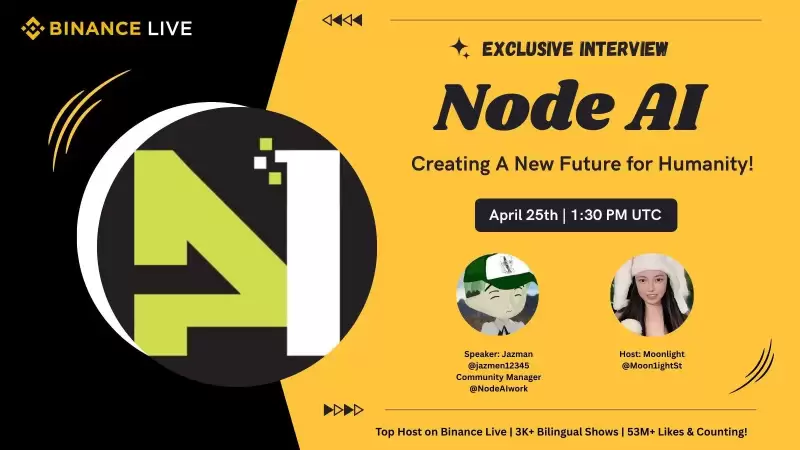
1. Can you give us a brief overview of what Node AI is and the mission behind the project?
Node AI is an innovative project that combines the power of artificial intelligence with decentralized technology. Our core mission is to democratize access to AI by making it open, transparent, and community-driven. In today’s world, AI is often monopolized by large corporations with opaque models and control over user data. We believe that AI should be a public good—accessible to developers, businesses, and individuals regardless of their background or resources.
Node AI leverages blockchain to create a decentralized ecosystem where AI models and data are governed by the community. This means that instead of relying on a single entity to manage how AI is used and trained, we allow the community to propose, vote, and build together. It’s an entirely new paradigm where AI is developed collaboratively and operates in a trustless, fair environment.
We’re building out infrastructure that supports open-source model training, decentralized data contribution, and transparent usage tracking. Whether you’re a data scientist, a Web3 enthusiast, or a curious user, Node AI gives you the tools to contribute meaningfully to the next wave of AI evolution.
2. What inspired the team to merge AI and blockchain technologies, and how do they complement each other in Node AI?
The fusion of AI and blockchain is a response to some of the biggest challenges facing AI today—centralization, lack of transparency, and biased data control. The Node AI team was inspired by the need to build AI systems that users could trust, audit, and co-create. We realized that blockchain provides the perfect foundation for achieving this, thanks to its inherent transparency, immutability, and decentralized governance.
AI models need data and computational power, but they also require trust in how they’re trained and deployed. Blockchain lets us record each step of model training, track the origin of data, and ensure fair rewards to contributors. In Node AI, we use smart contracts to automate governance and create verifiable incentives for users who share data or computing resources.
Moreover, the decentralized structure of Web3 allows us to escape the “walled garden” model where only big players win. In Node AI, contributors get direct ownership and benefits from the AI models they help develop. This synergy between AI and blockchain not only empowers individuals but also leads to more ethical, diverse, and accurate AI systems.
3. How does Node AI ensure data privacy and security, especially in a decentralized environment?
That’s a crucial question because data privacy and security are at the heart of everything we do at Node AI. In a decentralized ecosystem, it’s not enough to just protect data—we must also empower users to own it. Our architecture is built with multiple layers of security and privacy-preserving technologies to ensure that data contributors remain in full control.
First, we use zero-knowledge proofs (ZKPs) and federated learning mechanisms. This means users can contribute data to train models without ever exposing their raw information. The model learns from decentralized nodes where the data stays, and only aggregated learnings are shared—never the private data itself.
Secondly, we’ve implemented NodeVault, a decentralized, encrypted data storage layer. Think of it like a blockchain-native Dropbox for AI training—every data input is tokenized, permissioned, and timestamped. Access control is handled via smart contracts, so users can define exactly who can use their data, how, and for what duration. And most importantly, they can revoke permissions anytime.
In terms of community trust, every action—whether it’s uploading data, accessing a dataset, or training a model—is recorded on-chain. This provides full transparency and auditability. Lastly, our DAO-driven governance ensures that decisions about data usage, access policy, and AI development are made democratically, not behind closed doors.
4. Can you talk about Node AI’s token economy and how users are incentivized to participate in the ecosystem?
Absolutely. The Node AI ecosystem is powered by our native utility token, $NAIT, which is designed to reward meaningful contributions while maintaining a balanced, sustainable economy.
Here’s how it works: Users who contribute data to our training pipelines receive $NAIT tokens based on the quality, rarity, and relevance of the data they provide. Data is scored via a community validation layer, and the more valuable it is to the AI models, the greater the reward.
Model trainers, who use their compute resources to train or refine models within NodeLab, also earn $NAIT. This creates a circular economy where contributors are fairly compensated, and the network continues to grow stronger.
Moreover, when developers create AI models on our platform and tokenize them as NFTs, they can earn royalties whenever someone uses or modifies their models. This gives creators long-term income potential from their work, something that’s often missing in centralized AI environments.
Another subtle but significant feature of Node AI is the decoupling of Node token ownership and access to
Disclaimer:info@kdj.com
The information provided is not trading advice. kdj.com does not assume any responsibility for any investments made based on the information provided in this article. Cryptocurrencies are highly volatile and it is highly recommended that you invest with caution after thorough research!
If you believe that the content used on this website infringes your copyright, please contact us immediately (info@kdj.com) and we will delete it promptly.
-

- EU Finance Groups Push to Axe or Boost Tokenized Securities Cap to Avoid US Brain Drain
- Sep 11, 2026 at 12:05 am
- European finance and tokenization groups are fiercely lobbying EU lawmakers to either scrap or significantly increase the proposed €100 billion cap on tokenized financial instruments, citing fears of stifled growth and a competitive disadvantage against the US.
-
- XRP Analyst Crypto-asset-analysis: Bird Calls for Breakout at $1.48, While Others Debate Long-Term Valuations and Cyclical Patterns
- Sep 10, 2026 at 04:05 pm
- Crypto developer Bird highlights XRP's potential bull flag breakout at $1.48, while other analysts and enthusiasts weigh in on resistance levels, market cap implications for ambitious price targets, and historical boom-and-bust cycles.
-
- Unpacking Binance Trustpilot Reviews 2026: Separating Fact from Fiction Amidst 1-Star Claims
- Sep 10, 2026 at 04:05 pm
- Claims of 20 consecutive 1-star Binance Trustpilot reviews in 2026 are making waves, but our analysis reveals these snapshots are unverified and require critical scrutiny before being accepted as fact.
-
- Backpack Securities, Solana, and Stocks: A New Dawn for On-Chain Equity Exposure (But Read the Fine Print!)
- Sep 10, 2026 at 11:45 am
- Backpack Securities and Solana are expanding on-chain access to stocks via Sunrise, marking a significant step in tokenized equities. This move, however, comes with crucial disclosures about availability and rights.
-
-
-
-
-


