











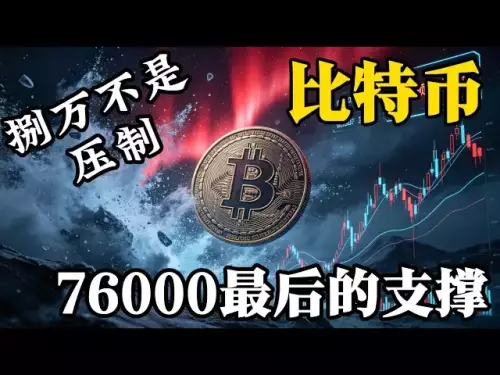


![There will be a violent washout of Bitcoin next. Don't buy the bottom too early. It won't stretch quickly in the short term. What you need to do now is to wait patiently for a good buying position, keep your bullets, and don't get hung up on it. When you buy the bottom, you will run out of bullets! Bitcoin market analysis [Issue 725]](/uploads/2026/08/23/cryptocurrencies-news/videos/origin_6a8afd33c749f_image_500_375.webp "There will be a violent washout of Bitcoin next. Don't buy the bottom too early. It won't stretch quickly in the short term. What you need to do now is to wait patiently for a good buying position, keep your bullets, and don't get hung up on it. When you buy the bottom, you will run out of bullets! Bitcoin market analysis [Issue 725]")






-
 bitcoin
 $76009.435780 USD
-1.53% - ethereum
$2375.311573 USD
-2.24% - tether
$0.999942 USD
0.01% - bnb
$682.047535 USD
-2.01% - xrp
$1.441787 USD
-5.55% - usd-coin
$1.000052 USD
0.00% - solana
$92.061879 USD
-1.80% - tron
$0.342038 USD
-0.93% - hyperliquid
$77.587999 USD
-1.41% - dogecoin
$0.089327 USD
-2.08% - zcash
$782.134934 USD
-0.71% - unus-sed-leo
$9.484522 USD
0.92% - chainlink
$11.132242 USD
-5.45% - monero
$431.110612 USD
0.39% - cardano
$0.214545 USD
-7.12%











How does NFT User Experience simplify the use process of NFTs?
Improved NFT UX simplifies the process through intuitive interfaces, streamlined workflows, and educational resources, addressing challenges like complex wallet management and blockchain interactions.
Mar 02, 2025 at 10:18 pm
- NFT user experience (UX) aims to simplify the often complex process of interacting with NFTs.
- This simplification is achieved through intuitive interfaces, streamlined workflows, and educational resources.
- Several platforms and tools are actively improving NFT UX, focusing on accessibility and ease of use.
- Challenges remain, particularly concerning scalability, security, and the integration of diverse blockchain networks.
The world of Non-Fungible Tokens (NFTs) can be intimidating for newcomers. Navigating blockchain technology, understanding gas fees, and managing digital wallets requires a level of technical expertise that many lack. Improving the NFT user experience (UX) is crucial for wider adoption. This involves making the entire process – from acquiring and managing to trading and displaying NFTs – significantly easier and more intuitive.
One major aspect of improved UX is the simplification of wallet management. Many early NFT platforms required users to interact directly with complex blockchain interfaces. Modern platforms offer simpler wallet integrations, often abstracting away the technical details. This allows users to manage their NFTs without needing deep technical knowledge. They can seamlessly buy, sell, and transfer assets with minimal hassle.
Another key element is the design of user interfaces (UIs). Early NFT marketplaces were often cluttered and difficult to navigate. Now, many platforms feature cleaner, more intuitive designs that prioritize ease of use. Features like improved search functionality, clear asset displays, and straightforward transaction processes contribute to a better overall experience.
Education plays a crucial role in simplifying NFT usage. Many platforms now include comprehensive educational resources to help users understand the basics of NFTs, blockchain technology, and the associated risks. These resources can range from interactive tutorials to detailed FAQs and support documentation, empowering users to make informed decisions.
The development of user-friendly tools further streamlines the process. Tools for managing NFT collections, tracking market trends, and even creating NFTs have become more accessible. These tools often feature drag-and-drop interfaces and simplified workflows, eliminating the need for advanced technical skills.
Many platforms are exploring innovative approaches to improve UX. This includes integrating NFTs directly into existing platforms and applications users already utilize, such as social media or gaming platforms. This removes the need for users to navigate separate marketplaces or wallets, creating a more seamless experience.
The integration of different blockchain networks is another area of focus. The ability to seamlessly interact with NFTs across various chains, without needing to switch between platforms or wallets, is a significant improvement. This enhances accessibility and allows for greater flexibility in managing and utilizing NFT assets.
However, challenges remain. Scalability continues to be a significant issue, especially with high transaction volumes. Gas fees, which can be substantial, remain a barrier to entry for many users. Security is another critical concern; platforms need to implement robust measures to protect user assets from theft or fraud.
Furthermore, the diversity of NFT types and their associated functionalities can lead to a fragmented user experience. Standardization and interoperability across different NFT platforms and protocols are necessary for a truly unified and streamlined experience. The development of universal standards and protocols is essential to overcome this fragmentation.
The ongoing development of NFT standards aims to improve interoperability between different NFT platforms. This would allow users to seamlessly transfer and manage NFTs across various ecosystems without encountering compatibility issues. The evolution of these standards is crucial for a more streamlined user experience.
Common Questions:Q: What are the biggest challenges in improving NFT UX?A: The biggest challenges include scalability (handling large transaction volumes efficiently), high gas fees (making transactions expensive), security (protecting user assets from theft), and the integration of diverse blockchain networks (allowing seamless interaction across different platforms).
Q: How do NFT marketplaces improve the user experience?A: NFT marketplaces improve UX through intuitive interfaces, streamlined workflows, integrated wallet management, educational resources, and tools for managing NFT collections.
Q: Are there any tools available to simplify NFT management?A: Yes, many tools are emerging to simplify NFT management. These include portfolio trackers, aggregators showing NFTs across different marketplaces, and tools for batch transfers and managing multiple wallets.
Q: What role does education play in simplifying NFT usage?A: Education is crucial. Platforms offering clear explanations of NFTs, blockchain technology, and associated risks empower users to make informed decisions and avoid scams.
Q: How can I learn more about improving my NFT experience?A: Explore various NFT marketplaces, read articles and tutorials on NFT technology, and engage with online communities dedicated to NFTs and blockchain technology. Pay attention to platform reviews and user feedback to identify user-friendly platforms.
Q: What are the future trends in NFT UX?A: Future trends include increased focus on seamless cross-chain interoperability, more sophisticated wallet management tools, and greater integration of NFTs into existing applications and platforms users already utilize. A move towards greater standardization of NFT protocols is also anticipated.
Disclaimer:info@kdj.com
The information provided is not trading advice. kdj.com does not assume any responsibility for any investments made based on the information provided in this article. Cryptocurrencies are highly volatile and it is highly recommended that you invest with caution after thorough research!
If you believe that the content used on this website infringes your copyright, please contact us immediately (info@kdj.com) and we will delete it promptly.





- Bitcoin, eCash Fork, and Airdrop Dynamics: A Deep Dive into Crypto's Latest Controversies
- 2026-05-03 12:55:01
- Consensus 2026 Miami: Web3, Blockchain, Cryptocurrency, NFTs, Metaverse, Conference, May 5th — Where Wall Street Meets the Digital Frontier
- 2026-05-02 12:45:01
- Fed Holds Rates Steady, Triggering Bitcoin Price Drop Amidst Geopolitical Tensions
- 2026-05-01 06:45:01
- Bitcoin Miners Electrify the Grid: Ohio Gas Plant Acquisition Powers Up a New Era for Digital Gold
- 2026-05-01 00:45:01
- MegaETH's MEGA Token Hits the Big Apple: Setting New Performance Benchmarks for Real-Time Blockchain
- 2026-05-01 00:55:01
- Solana's Slippery Slope: Price Prediction Points to Resistance Loss and Potential Further Drops
- 2026-05-01 06:45:01
Related knowledge
What Is an NFT Utility? What Do You Actually Get Besides the Digital Asset?
Aug 21,2026 at 09:40am
Bitcoin Halving Mechanics1. Bitcoin’s protocol enforces a fixed issuance schedule where block rewards are cut in half approximately every 210,000 bloc...
What Is an NFT Drop? How Do You Find New NFT Collections Before They Sell Out?
Aug 23,2026 at 02:40am
Bitcoin Halving Mechanics1. Bitcoin’s protocol enforces a fixed issuance schedule where block rewards are cut in half approximately every 210,000 bloc...
What Is a Free NFT Mint? Is “Free” Really Free After Gas Fees?
Aug 22,2026 at 10:00am
Market Volatility Patterns1. Bitcoin price swings often exceed 5% within a 24-hour window during high-liquidity events such as ETF approval announceme...
What Is an NFT Trait? How Do Traits Determine an NFT’s Rarity?
Aug 20,2026 at 10:00am
Understanding NFT Traits1. An NFT trait is a distinct visual or functional attribute embedded within a token’s metadata, such as background color, clo...
What Is a Blue-Chip NFT? Which Collections Are Considered Blue Chips?
Aug 21,2026 at 02:40am
Definition and Core Characteristics1. Blue-chip NFTs refer to digital assets that demonstrate consistent market resilience, strong community engagemen...
What Is an NFT Burn? Why Would Someone Destroy a Valuable NFT?
Aug 22,2026 at 07:20pm
Understanding NFT Burning1. NFT burning is the irreversible removal of a non-fungible token from circulation by sending it to an inaccessible blockcha...
What Is an NFT Utility? What Do You Actually Get Besides the Digital Asset?
Aug 21,2026 at 09:40am
Bitcoin Halving Mechanics1. Bitcoin’s protocol enforces a fixed issuance schedule where block rewards are cut in half approximately every 210,000 bloc...
What Is an NFT Drop? How Do You Find New NFT Collections Before They Sell Out?
Aug 23,2026 at 02:40am
Bitcoin Halving Mechanics1. Bitcoin’s protocol enforces a fixed issuance schedule where block rewards are cut in half approximately every 210,000 bloc...
What Is a Free NFT Mint? Is “Free” Really Free After Gas Fees?
Aug 22,2026 at 10:00am
Market Volatility Patterns1. Bitcoin price swings often exceed 5% within a 24-hour window during high-liquidity events such as ETF approval announceme...
What Is an NFT Trait? How Do Traits Determine an NFT’s Rarity?
Aug 20,2026 at 10:00am
Understanding NFT Traits1. An NFT trait is a distinct visual or functional attribute embedded within a token’s metadata, such as background color, clo...
What Is a Blue-Chip NFT? Which Collections Are Considered Blue Chips?
Aug 21,2026 at 02:40am
Definition and Core Characteristics1. Blue-chip NFTs refer to digital assets that demonstrate consistent market resilience, strong community engagemen...
What Is an NFT Burn? Why Would Someone Destroy a Valuable NFT?
Aug 22,2026 at 07:20pm
Understanding NFT Burning1. NFT burning is the irreversible removal of a non-fungible token from circulation by sending it to an inaccessible blockcha...
See all articles


