











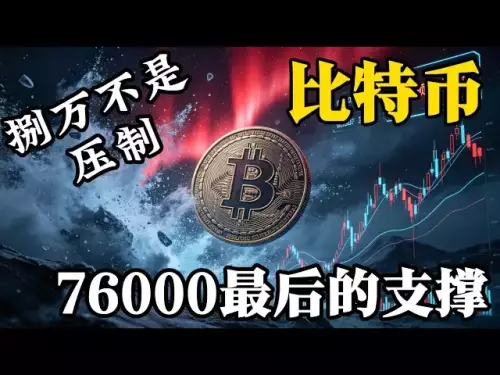


![There will be a violent washout of Bitcoin next. Don't buy the bottom too early. It won't stretch quickly in the short term. What you need to do now is to wait patiently for a good buying position, keep your bullets, and don't get hung up on it. When you buy the bottom, you will run out of bullets! Bitcoin market analysis [Issue 725]](/uploads/2026/08/23/cryptocurrencies-news/videos/origin_6a8afd33c749f_image_500_375.webp "There will be a violent washout of Bitcoin next. Don't buy the bottom too early. It won't stretch quickly in the short term. What you need to do now is to wait patiently for a good buying position, keep your bullets, and don't get hung up on it. When you buy the bottom, you will run out of bullets! Bitcoin market analysis [Issue 725]")






-
 bitcoin
 $76009.435780 USD
-1.53% - ethereum
$2375.311573 USD
-2.24% - tether
$0.999942 USD
0.01% - bnb
$682.047535 USD
-2.01% - xrp
$1.441787 USD
-5.55% - usd-coin
$1.000052 USD
0.00% - solana
$92.061879 USD
-1.80% - tron
$0.342038 USD
-0.93% - hyperliquid
$77.587999 USD
-1.41% - dogecoin
$0.089327 USD
-2.08% - zcash
$782.134934 USD
-0.71% - unus-sed-leo
$9.484522 USD
0.92% - chainlink
$11.132242 USD
-5.45% - monero
$431.110612 USD
0.39% - cardano
$0.214545 USD
-7.12%











How does DeepBook Protocol (DEEP) coin handle inflation?
DeepBook Protocol (DEEP) maintains price stability through adaptive supply adjustments, liquidity management strategies, holder incentives, and community-led governance, effectively combating inflation and promoting long-term sustainability.
Dec 21, 2024 at 09:47 pm
- DeepBook Protocol (DEEP) utilizes a unique tokenomics model to combat inflation through supply adjustments and liquidity management.
- The protocol maintains a stable coin price by adjusting the supply of DEEP tokens in response to market conditions.
- DEEP token holders benefit from supply suppression mechanisms and staking rewards, incentivizing long-term holding.
- Liquidity management strategies, including token burns and market maker partnerships, further enhance price stability.
- The DEEP ecosystem encourages community involvement and project governance, promoting long-term sustainability.
DeepBook Protocol (DEEP) has implemented a comprehensive approach to address inflation and maintain price stability within its ecosystem:
1. Supply Adjustment Mechanisms:- Adaptive Supply Adjustment: DEEP token issuance is directly linked to the native stablecoin, DEEPUSD. When DEEPUSD demand increases, more DEEP tokens are minted. Conversely, when demand decreases, DEEP tokens are burned.
- Buy-and-Burn Feature: A portion of all DEEP token transactions is allocated to a buy-and-burn mechanism. This reduces the circulating supply, creating upward price pressure.
- Liquidity Provision on DEXs: DEEP tokens are paired with liquidity pools on decentralized exchanges (DEXs), providing ample liquidity for traders and reducing price volatility.
- Market Maker Partnerships: DeepBook Protocol collaborates with reputable liquidity providers to enhance market depth and order execution speed.
- Token Burns: Periodically, a fraction of the circulating DEEP token supply is burned, removing tokens from the market and increasing the scarcity of the asset.
- Staking Rewards: DEEP token holders who stake their tokens in the protocol's governance platform earn rewards, encouraging long-term investment and reducing sell pressure.
- Governance Participation: Staked DEEP tokens grant holders voting rights, allowing them to influence project decisions and participate in community governance.
- Supply Suppression: By staking DEEP tokens, users contribute to the suppression of new token issuance, enhancing the value of their holdings.
- Community-Led Development: DeepBook Protocol actively seeks community input and feedback on its roadmap and development initiatives.
- Decentralized Governance: DEEP token holders wield the decision-making power through a decentralized autonomous organization (DAO), ensuring the long-term sustainability and alignment of the protocol with community interests.
Q: How does DEEUSD demand impact DEEP token supply?A: Increased DEEUSD demand leads to increased DEEP token issuance, while decreased demand triggers token burns, maintaining a price equilibrium.
Q: What is the role of token burns in combating inflation?A: Token burns permanently remove DEEP tokens from circulation, reducing supply and creating upward price pressure.
Q: How does staking DEEP tokens contribute to inflation management?A: Staking DEEP tokens suppresses new token issuance and incentivizes long-term holding, reducing sell pressure and enhancing price stability.
Q: What is the significance of market maker partnerships?A: Market maker partnerships ensure adequate liquidity for DEEP token traders, reducing price volatility and creating a more efficient market.
Q: How does community governance contribute to DEEP's resilience to inflation?A: Community governance allows DEEP token holders to influence project decisions and ensure the long-term sustainability and alignment of the protocol with community interests.
Disclaimer:info@kdj.com
The information provided is not trading advice. kdj.com does not assume any responsibility for any investments made based on the information provided in this article. Cryptocurrencies are highly volatile and it is highly recommended that you invest with caution after thorough research!
If you believe that the content used on this website infringes your copyright, please contact us immediately (info@kdj.com) and we will delete it promptly.






- Bitcoin, eCash Fork, and Airdrop Dynamics: A Deep Dive into Crypto's Latest Controversies
- 2026-05-03 12:55:01
- Consensus 2026 Miami: Web3, Blockchain, Cryptocurrency, NFTs, Metaverse, Conference, May 5th — Where Wall Street Meets the Digital Frontier
- 2026-05-02 12:45:01
- Fed Holds Rates Steady, Triggering Bitcoin Price Drop Amidst Geopolitical Tensions
- 2026-05-01 06:45:01
- Bitcoin Miners Electrify the Grid: Ohio Gas Plant Acquisition Powers Up a New Era for Digital Gold
- 2026-05-01 00:45:01
- MegaETH's MEGA Token Hits the Big Apple: Setting New Performance Benchmarks for Real-Time Blockchain
- 2026-05-01 00:55:01
- Solana's Slippery Slope: Price Prediction Points to Resistance Loss and Potential Further Drops
- 2026-05-01 06:45:01
Related knowledge
How much did BNB cost in its early days?
Aug 20,2026 at 04:00pm
BNB Initial Token Sale Price1. BNB was launched in July 2017 during Binance’s initial coin offering. 2. The token sale price was set at 0.1 ETH per BN...
What was BNB's highest price in history?
Aug 15,2026 at 03:20am
Historical Price Peak1. BNB reached its all-time high of $795.00 on December 4, 2024, according to real-time market data tracked by CoinGecko and veri...
How much has BNB increased since its beginning?
Aug 16,2026 at 08:40pm
BNB Initial Token Sale and Early Market Performance1. BNB was launched in July 2017 during Binance’s initial coin offering, priced at $0.10 per token....
What was BNB worth when it first launched?
Aug 13,2026 at 04:40pm
Initial Token Sale and Launch Price1. BNB was introduced during its initial coin offering in July 2017 on the Ethereum blockchain as an ERC-20 token. ...
How high can BNB go in the future?
Aug 21,2026 at 01:40pm
BNB Price Dynamics and Market Positioning1. BNB remains the native utility token of the Binance ecosystem, deeply embedded in trading fee discounts, s...
What is the highest BNB price ever recorded?
Aug 13,2026 at 05:59pm
Bitcoin Halving Mechanics1. Bitcoin’s protocol enforces a fixed issuance schedule where block rewards are cut in half approximately every 210,000 bloc...
How much did BNB cost in its early days?
Aug 20,2026 at 04:00pm
BNB Initial Token Sale Price1. BNB was launched in July 2017 during Binance’s initial coin offering. 2. The token sale price was set at 0.1 ETH per BN...
What was BNB's highest price in history?
Aug 15,2026 at 03:20am
Historical Price Peak1. BNB reached its all-time high of $795.00 on December 4, 2024, according to real-time market data tracked by CoinGecko and veri...
How much has BNB increased since its beginning?
Aug 16,2026 at 08:40pm
BNB Initial Token Sale and Early Market Performance1. BNB was launched in July 2017 during Binance’s initial coin offering, priced at $0.10 per token....
What was BNB worth when it first launched?
Aug 13,2026 at 04:40pm
Initial Token Sale and Launch Price1. BNB was introduced during its initial coin offering in July 2017 on the Ethereum blockchain as an ERC-20 token. ...
How high can BNB go in the future?
Aug 21,2026 at 01:40pm
BNB Price Dynamics and Market Positioning1. BNB remains the native utility token of the Binance ecosystem, deeply embedded in trading fee discounts, s...
What is the highest BNB price ever recorded?
Aug 13,2026 at 05:59pm
Bitcoin Halving Mechanics1. Bitcoin’s protocol enforces a fixed issuance schedule where block rewards are cut in half approximately every 210,000 bloc...
See all articles


