














 |
|
 |
|
 |
|
 |
|
 |
|
 |
|
 |
|
 |
|
 |
|
 |
|
 |
|
 |
|
 |
|
 |
|
 |
|
Articles d’actualité sur les crypto-monnaies
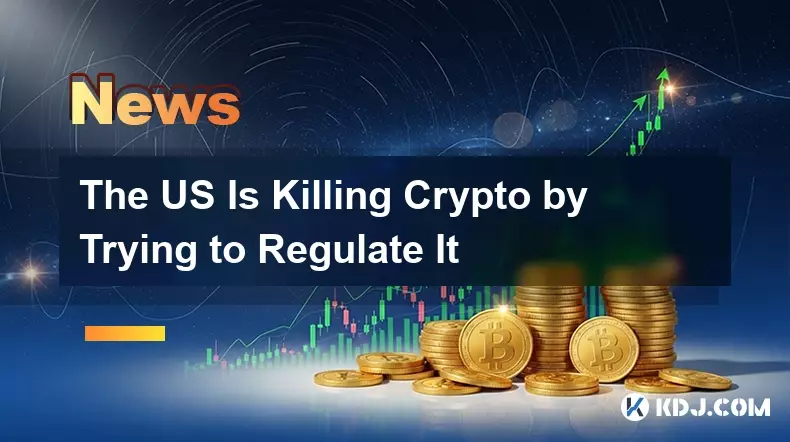
The US Is Killing Crypto by Trying to Regulate It
May 05, 2025 at 05:26 pm
For years, launching a crypto project in the United States has been a maze of uncertainty. Legal ambiguity and a hostile regulatory environment have driven founders offshore, turning places like Switzerland and the Cayman Islands into global hubs for blockchain innovation.
With Trump’s election, things finally started to change, with a US administration openly declaring its intention to be crypto-friendly and welcoming the industry to set up shop in the States.
Yet, despite the administration’s stated enthusiasm for crypto, nothing concrete has changed so far. It’s still nearly impossible to launch a crypto project in the US, and the government’s actions continue to drive founders away.
This isn’t for lack of trying on the part of crypto founders. Nearly every founder is aware of the legal and regulatory risks, and many are actively seeking to cooperate with the government. But, unfortunately, the government isn’t making it easy.
Instead of offering clear guidance, US regulatory agencies continue to offer nothing but vague threats and “regulation by enforcement” lawsuits. They want America to be a leader in crypto, but, even under the Trump administration, they aren’t taking action to create the conditions that would make that happen.
So while the administration is talking up its desire to be crypto-friendly, its actions are having the opposite effect, slowly killing the crypto industry in America.
Every crypto project faces the same fundamental problem: Achieving decentralization is critical to avoid regulatory scrutiny, but until a project launches its token, a degree of centralization is unavoidable.
A project must have a core team that builds the product, raises funds, manages legal affairs, and performs other tasks essential for the project’s survival. This team necessarily exercises a high degree of control over the project’s destiny during the early stages of growth.
However, if a project remains centralized, it faces immediate threat from the SEC, which will likely classify its token as a security under the outdated Howey test. The logic here is self-defeating. Projects can’t decentralize without launching a token, but launching a token in the US instantly puts them in the SEC’s crosshairs.
This isn’t just a theoretical issue; it has real consequences. Liquidity providers, essential for all new token launches, won’t engage with US-based projects because they assume their tokens will be classified as securities. Centralized exchanges refuse to list tokens issued from US entities for the same reason. Even decentralized exchanges face pressure from their legal teams to avoid actively seeding liquidity for American projects.
The result? US founders are boxed out of the global crypto economy before they even get started. They can’t raise fiat to fund development, and they can’t launch a token to decentralize the project and begin community participation. Instead, they are forced to wind down their operations and seek opportunities in offshore jurisdictions.
This regulatory failure has spawned an entire cottage industry of offshore legal firms specializing in setting up token-issuing entities. With its FINMA no-action letter system, Switzerland has become a hotbed for crypto projects because it offers one of the few structured ways to get legal clarity on a token’s classification. The Cayman Islands and British Virgin Islands have also established themselves as crypto safe havens, providing flexible corporate structures that allow projects to operate with far less regulatory risk.
Recently, a report by the US Treasury highlighted the threat posed by Huobi to the US financial system due to its alleged facilitation of North Korean founders laundering funds through the exchange. While the report's claims of Huobi's involvement in North Korean money laundering are certainly concerning, it's ironic that the Treasury is now cutting off Huobi over ties to crypto crime.
The absurdity is that the actual work — the development, the hiring, the innovation — still happens in the US. The token issuance gets pushed offshore via “Associations” and “Foundations,” which serve non-profits operating independently of US-based development shops. American founders are forced to funnel money into unnecessary legal fees, overseas operators, and shell foundations to avoid the inevitable crackdown from US regulators.
This isn’t just bad for crypto; it’s bad for America. The US is hemorrhaging talent, investment, and influence to less myopic jurisdictions. It’s no secret that the US is losing the global crypto race, and until it can be solved, the gap will continue to widen.
The US has spent years fumbling crypto policy, and now, even with an administration that claims to be pro-crypto, it’s still failing to deliver real change.
Some have suggested that the US should offer capital gains tax exemptions on crypto to encourage founders to stay in the States. But this does little to help. It’s not the tax implications that are driving founders offshore; it’s the threat of immediate regulatory action and the lack of clear guidance.
If the US truly wants to be a leader in crypto, it also must take the lead in
Clause de non-responsabilité:info@kdj.com
Les informations fournies ne constituent pas des conseils commerciaux. kdj.com n’assume aucune responsabilité pour les investissements effectués sur la base des informations fournies dans cet article. Les crypto-monnaies sont très volatiles et il est fortement recommandé d’investir avec prudence après une recherche approfondie!
Si vous pensez que le contenu utilisé sur ce site Web porte atteinte à vos droits d’auteur, veuillez nous contacter immédiatement (info@kdj.com) et nous le supprimerons dans les plus brefs délais.
-

- Altcoin Market Rising : Quack AI (Q) et les pièces de confidentialité attirent l'attention avec Altcoin Rising
- Oct 21, 2026 at 04:05 pm
- Le marché de l'Altcoin devient actif ! Aux côtés des crypto-monnaies et des memecoins axés sur la confidentialité, le jeton Q de Quack AI attire également l'attention des investisseurs avec une forte hausse. Cette fluctuation pourrait-elle être le signe avant-coureur d’un nouveau rallye ?
-
- Binance US et Blockchain.com s'intéressent aux marchés de prédiction de cryptographie au milieu d'un changement dans l'industrie
- Oct 21, 2026 at 04:05 pm
- Binance US et Blockchain.com explorent de nouvelles sources de revenus avec les marchés de prédiction de cryptographie alors que l'industrie de la cryptographie est confrontée à un ralentissement et à un examen réglementaire.
-
- Le réseau Qubic renaît de ses cendres : la récupération et les réclamations en cas de vol QU sont désormais ouvertes !
- Oct 21, 2026 at 12:05 pm
- Le réseau Qubic redémarre avec succès après un vol de 2 940 milliards de QU, les demandes de récupération étant désormais ouvertes jusqu'en mai 2027, offrant une bouée de sauvetage aux utilisateurs concernés.
-
- Les ETF Bitcoin américains enregistrent des afflux massifs, l'IBIT de BlackRock est en tête du peloton au milieu de l'évolution du sentiment cryptographique
- Oct 21, 2026 at 07:55 am
- Les ETF Bitcoin américains ont connu des entrées importantes, avec l'IBIT de BlackRock en tête, soulignant une forte demande institutionnelle tandis que les ETF Ethereum connaissent des sorties. Explorez les dernières tendances et idées.
-
- Hausse des prix du financement des aérodromes (AERO) : qu’est-ce qui alimente le dernier rallye ?
- Oct 21, 2026 at 07:45 am
- Le jeton AERO d'Aerodrome Finance connaît une hausse notable, grimpant de plus de 10 % en 24 heures pour atteindre 0,880536 $, se rapprochant de son sommet historique de 0,9935 $. Cette décision est motivée par son rôle central dans l’écosystème de base et par la robuste activité du marché.
-
- Les détenteurs de Bitcoin accumulent gros : BTC constate des afflux importants dans un contexte de dynamique de marché changeante
- Oct 21, 2026 at 04:05 am
- L’analyse révèle une accumulation importante de la part des principaux détenteurs de Bitcoin, avec le réveil des portefeuilles en sommeil depuis longtemps. Cela déplace l’attention sur les positions à long terme et les impacts potentiels sur le marché pour Bitcoin BTC.
-
- XRP, protocole NEAR et confidentialité : une nouvelle ère de transactions cryptographiques confidentielles
- Oct 21, 2026 at 04:05 am
- L'intégration de XRP par NEAR Protocol introduit des transactions confidentielles par défaut, marquant une avancée significative en matière de confidentialité dans le domaine de la cryptographie, permettant des échanges et des paiements sécurisés tout en soulignant la demande croissante d'activités privées en chaîne.
-
- Sparkassen révolutionne le secteur bancaire : le trading au comptant de crypto-monnaie est désormais disponible dans l'application bancaire
- Oct 21, 2026 at 04:05 am
- La société allemande Sparkassen intègre le trading au comptant de crypto-monnaies dans son application bancaire, offrant ainsi un point d'entrée réglementé aux clients. Cette décision marque un changement important dans le secteur bancaire traditionnel.
-
- OpenZeppelin et Chainlink forgent une nouvelle norme d'outillage pour la DeFi institutionnelle
- Oct 21, 2026 at 04:05 am
- OpenZeppelin et Chainlink ont uni leurs forces, intégrant CCIP et ACE de Chainlink dans la bibliothèque de développement d'OpenZeppelin, établissant ainsi une nouvelle norme d'outils pour une finance en chaîne sécurisée, conforme et évolutive.


