





![[ENG SUB]✨A Contract Wife With Many Secrets Turned The Cold General’s Heart Into True Love#drama](/uploads/2026/09/18/cryptocurrencies-news/videos/origin_6aacdd2b81574_image_500_375.webp "[ENG SUB]✨A Contract Wife With Many Secrets Turned The Cold General’s Heart Into True Love#drama")






 |
|
 |
|
 |
|
 |
|
 |
|
 |
|
 |
|
 |
|
 |
|
 |
|
 |
|
 |
|
 |
|
 |
|
 |
|
Cryptocurrency News Articles
AI Infrastructure: Navigating Future Trends and the Evolving Technology Landscape
Nov 11, 2025 at 11:05 pm
Explore the future of AI infrastructure, key trends, and the evolving technology landscape, focusing on distributed inference, multimodal data engineering, and resource management.
AI Infrastructure: Navigating Future Trends and the Evolving Technology Landscape
The dynamics of AI infrastructure, future trends, and the technology landscape are rapidly evolving. This article synthesizes key findings and trends, focusing on distributed inference, multimodal data engineering, and efficient resource management.
Distributed Inference: The New Standard
Serving large and mixture-of-experts models has transformed into a distributed systems challenge. "Distributed inference" involves intricate orchestration, splitting computation between prompt processing and token generation, routing requests to different expert models, and managing key-value cache transfers. This complexity is now the baseline for deploying frontier models in production.
Ray Tie-in: Ray's actor model allows precise placement and communication between different model parts running on separate hardware, enabling advanced routing and parallelism.
Post-Training and Reinforcement Learning Take Center Stage
The most significant improvements now occur after pre-training, including alignment, fine-tuning, and reinforcement learning. AI teams focus on reward modeling, data curation from live traffic, and rapid iteration of small variants, rather than solely on pre-training compute.
Ray Tie-in: Ray manages complex compute patterns inherent in reinforcement learning, coordinating data generation, reward modeling, and model updates. Nearly every major open-source post-training framework is built on Ray.
Multimodal Data Engineering Becomes First-Class
AI data pipelines are evolving beyond text-only workloads to process diverse data types like images, video, audio, and sensor data. This transition complicates the initial data processing stage, requiring CPUs for general transformations and GPUs for specialized tasks like generating embeddings. Data processing is now a sophisticated, heterogeneous distributed computing problem.
Ray Tie-in: Ray orchestrates tasks across heterogeneous CPU and GPU clusters, essential for building efficient data pipelines. The Ray Data library is enhanced to handle large tensors and diverse data formats.
Agentic Workflows and Continuous Loops
Applications are shifting to systems that plan, invoke tools/models, check results, and learn from feedback continuously. These loops span data collection, post-training, deployment, and evaluation. Infrastructure must support coordinating long-running workflows across these stages for faster product learning cycles.
Ray Tie-in: Ray’s actor model supports long-lived agents, coordinating tool use and evaluations. The same cluster runs data preparation, training, and serving, avoiding the need to integrate multiple platforms.
Global GPU Scheduling and Cost Control
Efficient GPU utilization is crucial. Policy-driven schedulers preempt low-priority jobs during traffic spikes, resuming them later, leading to higher utilization, lower costs, and faster developer startup times.
Ray Tie-in: Anyscale’s platform uses a global resource scheduler built on Ray, providing a centralized system for managing constrained resources across an organization.
Cloud-Native and Multi-Cloud Strategies
GPU scarcity drives enterprises to multi-cloud strategies, distributing workloads across AWS, Google Cloud, Azure, and specialized GPU clouds. This addresses availability and avoids vendor lock-in but introduces complexity.
Ray Tie-in: Ray/Anyscale provides a common runtime across multiple clouds, allowing teams to chase capacity without rebuilding systems.
Evaluation-Driven Operations for Non-Deterministic Systems
AI models are non-deterministic systems whose behavior can drift in production. Continuous evaluations tied to product metrics and feedback into post-training are essential. Iteration speed—collect, retrain, redeploy, re-measure—is critical.
Ray Tie-in: Ray hosts the full loop on one substrate, reusing the same primitives for data collection, evaluation jobs, training runs, and rollouts. Ray actors maintain state across evaluation runs, enabling sophisticated monitoring patterns.
Reliability at Scale on Unreliable Hardware
Operating AI infrastructure at scale requires designing for failure. Production systems must incorporate robust fault tolerance, including automatic retries, job checkpointing, and graceful handling of worker failures.
Ray Tie-in: Ray has invested significantly in reliability and fault tolerance. Its internal state management system is re-architected for high availability, and system processes are isolated from application resource pressure. Ray’s support for checkpointing is critical for long-running training jobs.
Heterogeneous Clusters: The Baseline
Pipelines blend CPUs (parsing, aggregation) with GPUs (embeddings, vision/audio transforms) across many nodes.
Ray Tie-in: Ray handles dynamic orchestration across heterogeneous hardware, allowing developers to specify resource requirements declaratively.
Accelerators and Fast Interconnects Determine Throughput
Specialized AI data centers with purpose-built accelerators connected via high-speed networking technologies are becoming standard, shifting from general-purpose cloud computing to specialized infrastructure.
Ray Tie-in: Ray Direct Transport enables direct GPU-to-GPU transfers, improving utilization for RL, distributed inference, and multimodal training.
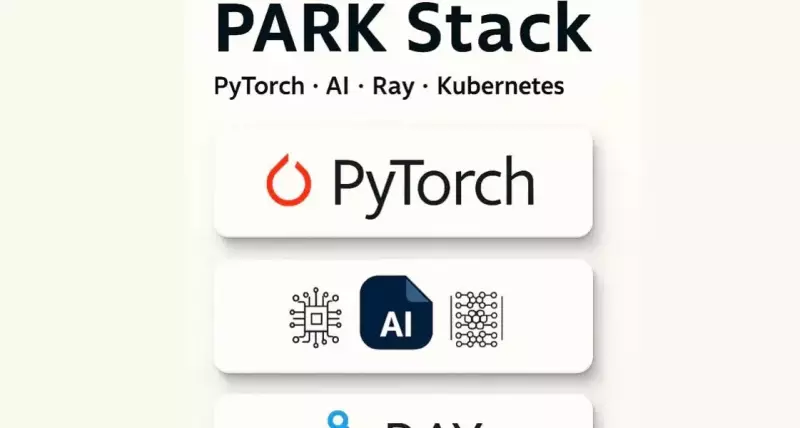
The PARK Stack
A stack is coalescing into clear layers: Kubernetes for provisioning resources, Ray for scaling applications, foundation models, and high-level frameworks like PyTorch.
Ray Tie-in: Ray unifies data processing, training, and distributed inference into one operational substrate and plugs into model stacks and Kubernetes. Joining the PyTorch Foundation signals tighter integration with the training/serving ecosystem.
Decentralized AI Infrastructure
Initiatives like Pi Network's proof-of-concept with OpenMind explore decentralized node architectures for AI training, potentially democratizing access to AI infrastructure.
Final Thoughts
The future of AI infrastructure is dynamic and exciting, with trends pointing toward more efficient, scalable, and accessible systems. Keep experimenting and pushing the boundaries – the possibilities are endless!
Disclaimer:info@kdj.com
The information provided is not trading advice. kdj.com does not assume any responsibility for any investments made based on the information provided in this article. Cryptocurrencies are highly volatile and it is highly recommended that you invest with caution after thorough research!
If you believe that the content used on this website infringes your copyright, please contact us immediately (info@kdj.com) and we will delete it promptly.
-

- AVAX Price Surges as Avalanche Chain Embraces Tokenized Funds and Institutional Growth
- Sep 18, 2026 at 04:05 pm
- Avalanche's recent rebound and strategic moves into tokenized funds and institutional liquidity signal a potential turning point for AVAX, as the network positions itself for long-term growth and broader adoption.
-
- Bank of Japan's Rate Hike: Yen, Bitcoin, and the Unwinding of Carry Trades
- Sep 18, 2026 at 12:05 pm
- The Bank of Japan's recent interest rate hike sends ripples through global markets, making yen-funded trades pricier and impacting Bitcoin's standing against the Japanese currency, while sparking debates on capital flows and risk asset volatility.
-
-
- CFTC Offers Broker Registration Relief for Passive Crypto Trading Software, Signals Broader Regulatory Shift
- Sep 18, 2026 at 11:55 am
- The CFTC is providing significant relief for passive crypto trading software, easing broker registration burdens and signaling a proactive approach to crypto regulation amid legislative delays.
-
- U.S. Tightens Grip: New Sanctions Target Iranian Crypto Exchange BitBank Amid Maritime Payment Probe
- Sep 18, 2026 at 11:55 am
- The U.S. Treasury has sanctioned BitBank, an Iranian cryptocurrency exchange, for allegedly facilitating Bitcoin payments linked to maritime traffic through the Strait of Hormuz.
-
- US Treasury Sanctions Iranian Exchange BitBank Over $1 Billion in Crypto Flows: A New York Take
- Sep 18, 2026 at 11:55 am
- The US Treasury has sanctioned Iran-based BitBank, alleging it processed $1 billion in Bitcoin for Iran's Revolutionary Guard through the 'Hormuz Safe' scheme, signaling Washington's intensified crackdown on crypto-based sanctions evasion.
-
- North Korea Malware & Asia Express: CoinEx's Exit Amidst a Shifting Digital Landscape
- Sep 18, 2026 at 08:05 am
- Amidst rising North Korean cyber threats and a dynamic Asian crypto scene, CoinEx, a Hong Kong-founded exchange, shutters after nine years, signaling a pivotal moment for regional digital asset markets and regulatory landscapes.
-
-
- Vitalik Buterin Challenges AI Cybersecurity Doom Narrative, Advocates for Formal Verification
- Sep 18, 2026 at 12:05 am
- Vitalik Buterin, Ethereum co-founder, refutes the 'AI doom narrative' in cybersecurity, asserting AI's potential to bolster defenses through formal verification, a stance underpinned by Ethereum's ongoing security research.


