















![Ultra Paracosm by IlIRuLaSIlI [3 coin] | Easy demon | Geometry dash](/uploads/2026/01/31/cryptocurrencies-news/videos/origin_697d592372464_image_500_375.webp "Ultra Paracosm by IlIRuLaSIlI [3 coin] | Easy demon | Geometry dash")








-
 bitcoin
 $87959.907984 USD
1.34% - ethereum
$2920.497338 USD
3.04% - tether
$0.999775 USD
0.00% - xrp
$2.237324 USD
8.12% - bnb
$860.243768 USD
0.90% - solana
$138.089498 USD
5.43% - usd-coin
$0.999807 USD
0.01% - tron
$0.272801 USD
-1.53% - dogecoin
$0.150904 USD
2.96% - cardano
$0.421635 USD
1.97% - hyperliquid
$32.152445 USD
2.23% - bitcoin-cash
$533.301069 USD
-1.94% - chainlink
$12.953417 USD
2.68% - unus-sed-leo
$9.535951 USD
0.73% - zcash
$521.483386 USD
-2.87%











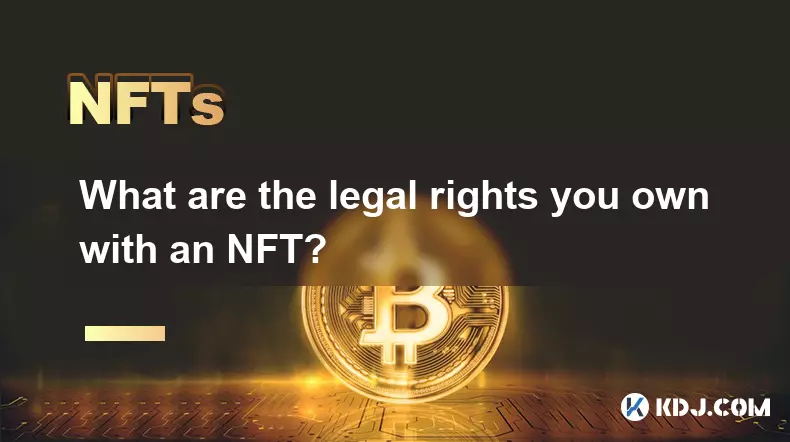
What are the legal rights you own with an NFT?
Buying an NFT grants ownership of a unique token, not necessarily the copyright or full rights to the underlying content—always check the license terms.
Oct 30, 2025 at 04:18 pm
Understanding Ownership in the NFT Space
1. When you purchase an NFT, you acquire ownership of a unique digital token recorded on a blockchain. This token acts as proof of authenticity and provenance for a specific digital asset, such as artwork, music, or collectibles. However, owning the NFT does not automatically grant ownership of the underlying intellectual property (IP) associated with the digital file.
2. The rights conveyed depend entirely on the terms set by the creator or issuer at the time of sale. In most cases, buyers receive a license to use, display, or resell the NFT. This license is often non-exclusive, meaning the creator can still use or monetize the same content. Some projects, like certain Bored Ape Yacht Club NFTs, offer commercial usage rights, allowing owners to create derivative products or services based on the artwork.
3. Blockchain technology ensures that ownership history and transfer records are transparent and immutable. Each transaction involving the NFT is permanently logged, providing verifiable proof of chain-of-ownership. This feature enhances trust in digital scarcity and helps prevent fraud in secondary markets.
4. Licensing agreements may be embedded in smart contracts or outlined in external documentation linked to the NFT. These terms dictate whether the owner can commercially exploit the work, modify it, or restrict others from using it. Buyers must carefully review these conditions before assuming broad rights.
5. Jurisdictional laws also influence how NFT ownership is interpreted legally. Different countries have varying regulations regarding digital assets, copyright, and consumer protection. As a result, legal interpretations of NFT rights can differ significantly across regions, creating complexity for global transactions.
Rights Typically Associated with NFT Ownership
1. Personal use rights are commonly granted, allowing owners to display the associated digital asset in personal spaces, online galleries, or social media profiles. This right supports individual expression but stops short of permitting public performances or broadcasts without additional permissions.
2. Transferability is a core feature of NFTs. Owners have the right to sell, trade, or gift their NFTs freely on supported marketplaces. Smart contracts often include royalty mechanisms that automatically compensate original creators upon resale.
3. Access to exclusive communities or events may be tied to certain NFTs. Projects frequently use token ownership as a membership key, granting holders entry to private forums, virtual experiences, or real-world gatherings.
4. Some NFTs come with physical counterparts or redeemable benefits, such as merchandise, tickets, or signed memorabilia. The digital token serves as both a certificate of ownership and a claim instrument for these tangible perks.
5. Governance rights are emerging in decentralized projects where NFT holders can vote on platform decisions, funding allocations, or creative direction. These rights reflect a shift toward community-driven ecosystems within the crypto space.
Limitations and Misconceptions About NFT Rights
1. Owning an NFT does not equate to owning the copyright of the associated digital content unless explicitly stated. Copyright law generally remains with the creator unless formally transferred through legal documentation.
2. Reproduction rights are typically restricted. Even if you own the NFT, downloading the image and printing copies for sale could infringe on the creator’s IP rights. Unauthorized duplication undermines the value proposition of digital scarcity.
3. Trademark usage is rarely included. Using an NFT's imagery to brand products or services might violate trademark laws, especially if the design resembles established logos or brands.
4. Derivative works require permission. Creating new art, animations, or adaptations based on the original NFT content usually demands explicit authorization from the rights holder, even if you own the token.
5. Market volatility and platform dependency pose practical risks. If the marketplace hosting the NFT shuts down or the metadata becomes inaccessible, the perceived value and usability of the asset may diminish despite continued blockchain ownership.
Frequently Asked Questions
Can I copyright an NFT I bought?No, purchasing an NFT does not transfer copyright ownership unless the seller explicitly assigns those rights. You may hold the token, but the original creator retains copyright by default under most jurisdictions.
Do all NFTs grant commercial usage rights?No, commercial rights vary widely between projects. Some explicitly allow commercial exploitation, while others strictly prohibit it. Always check the licensing terms provided by the issuer before using an NFT for business purposes.
What happens to my NFT if the issuing platform closes?The blockchain record of your NFT remains intact, but access to associated files or services may be lost if they rely on centralized servers. Decentralized storage solutions like IPFS help mitigate this risk by preserving metadata independently.
Can someone else copy my NFT’s image?Yes, anyone can view and screenshot the digital file linked to an NFT. However, they won’t own the verified token on the blockchain. While replication is technically possible, the authenticity and ownership remain secured through cryptographic verification.
Disclaimer:info@kdj.com
The information provided is not trading advice. kdj.com does not assume any responsibility for any investments made based on the information provided in this article. Cryptocurrencies are highly volatile and it is highly recommended that you invest with caution after thorough research!
If you believe that the content used on this website infringes your copyright, please contact us immediately (info@kdj.com) and we will delete it promptly.






- Work Dogs Unleashes TGE Launch, Sets Sights on Mid-2026 Listing & Ambitious $25 Token Target
- 2026-01-31 15:50:02
- WD Coin's TGE Launch Ignites Excitement: A Billion Tokens Set to Hit the Market
- 2026-01-31 16:10:02
- Royal Mint Launches Interactive £5 Coin for a Thrilling Code-Breaker Challenge
- 2026-01-31 16:10:02
- Crypto, AI, and Gains: Navigating the Next Wave of Digital Assets
- 2026-01-31 15:50:02
- Coin Nerds Forges Trust in the Digital Asset Trading Platform Landscape Amidst Evolving Market
- 2026-01-31 16:05:01
- Blockchains, Crypto Tokens, Launching: Enterprise Solutions & Real Utility Steal the Spotlight
- 2026-01-31 12:30:02
Related knowledge
How to understand gas wars and set priority fees? (Minting strategy)
Jan 29,2026 at 11:00am
Understanding Gas Wars in the Context of NFT Minting1. Gas wars occur when multiple users compete to have their transactions confirmed first on Ethere...
How to buy real estate using NFTs? (RWA tokenization)
Jan 29,2026 at 07:19am
Understanding Real Estate NFTs1. Real estate NFTs represent ownership stakes in physical properties through blockchain-based tokens. 2. Each NFT is mi...
How to participate in NFT raffles and giveaways? (Premint guide)
Jan 29,2026 at 11:39pm
Understanding NFT Raffle Mechanics1. NFT raffles operate as on-chain lotteries where participants submit entries during a defined window, often by con...
How to set up an NFT gallery in a virtual world? (OnCyber tutorial)
Jan 28,2026 at 07:19am
Understanding Virtual World Infrastructure1. Virtual worlds like Decentraland, Somnium Space, and OnCyber rely on blockchain-based land ownership, whe...
How to bridge NFTs across different blockchains? (Wormhole guide)
Jan 29,2026 at 05:20am
Understanding Cross-Chain NFT Bridging1. NFTs are inherently tied to the blockchain where they are minted, making them non-transferable by default acr...
How to spot wash trading in NFT collections? (Volume analysis)
Jan 30,2026 at 09:20am
Volume Distribution Patterns1. A small number of wallets consistently account for over 70% of total trading volume across multiple floor price transac...
How to understand gas wars and set priority fees? (Minting strategy)
Jan 29,2026 at 11:00am
Understanding Gas Wars in the Context of NFT Minting1. Gas wars occur when multiple users compete to have their transactions confirmed first on Ethere...
How to buy real estate using NFTs? (RWA tokenization)
Jan 29,2026 at 07:19am
Understanding Real Estate NFTs1. Real estate NFTs represent ownership stakes in physical properties through blockchain-based tokens. 2. Each NFT is mi...
How to participate in NFT raffles and giveaways? (Premint guide)
Jan 29,2026 at 11:39pm
Understanding NFT Raffle Mechanics1. NFT raffles operate as on-chain lotteries where participants submit entries during a defined window, often by con...
How to set up an NFT gallery in a virtual world? (OnCyber tutorial)
Jan 28,2026 at 07:19am
Understanding Virtual World Infrastructure1. Virtual worlds like Decentraland, Somnium Space, and OnCyber rely on blockchain-based land ownership, whe...
How to bridge NFTs across different blockchains? (Wormhole guide)
Jan 29,2026 at 05:20am
Understanding Cross-Chain NFT Bridging1. NFTs are inherently tied to the blockchain where they are minted, making them non-transferable by default acr...
How to spot wash trading in NFT collections? (Volume analysis)
Jan 30,2026 at 09:20am
Volume Distribution Patterns1. A small number of wallets consistently account for over 70% of total trading volume across multiple floor price transac...
See all articles


