











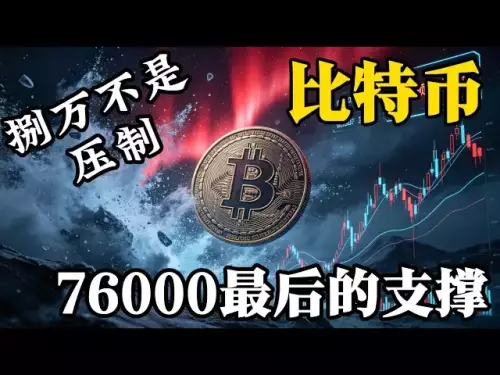


![There will be a violent washout of Bitcoin next. Don't buy the bottom too early. It won't stretch quickly in the short term. What you need to do now is to wait patiently for a good buying position, keep your bullets, and don't get hung up on it. When you buy the bottom, you will run out of bullets! Bitcoin market analysis [Issue 725]](/uploads/2026/08/23/cryptocurrencies-news/videos/origin_6a8afd33c749f_image_500_375.webp "There will be a violent washout of Bitcoin next. Don't buy the bottom too early. It won't stretch quickly in the short term. What you need to do now is to wait patiently for a good buying position, keep your bullets, and don't get hung up on it. When you buy the bottom, you will run out of bullets! Bitcoin market analysis [Issue 725]")






-
 bitcoin
 $77390.856017 USD
1.82% - ethereum
$2456.627593 USD
3.42% - tether
$0.999956 USD
0.00% - bnb
$699.463251 USD
2.55% - xrp
$1.480470 USD
2.68% - usd-coin
$1.000048 USD
0.00% - solana
$94.253862 USD
2.38% - tron
$0.344425 USD
0.70% - hyperliquid
$79.695030 USD
2.72% - dogecoin
$0.091914 USD
2.81% - zcash
$844.721786 USD
8.00% - chainlink
$11.522210 USD
3.50% - unus-sed-leo
$9.308855 USD
-1.85% - cardano
$0.219612 USD
2.36% - monero
$416.052091 USD
-3.62%











What is a Public Key? (Wallet Addresses)
A public key is a cryptographically derived, shareable identifier—hashed and encoded into a wallet address—enabling secure asset receipt without exposing the private key.
Mar 21, 2026 at 02:00 pm
What Is a Public Key in Cryptocurrency?
1. A public key is a cryptographic string derived from a private key through elliptic curve multiplication, serving as the mathematical foundation for wallet address generation.
2. It functions as a globally visible identifier that allows others to send digital assets to a specific wallet without exposing the private key.
3. Unlike private keys, public keys are designed to be shared freely across networks, enabling transparent yet secure transaction routing.
4. In Bitcoin, the public key undergoes SHA-256 and RIPEMD-160 hashing to produce a P2PKH address, while newer protocols like SegWit and Taproot use different derivation paths.
5. Ethereum uses a simpler transformation: the Keccak-256 hash of the public key is truncated to 20 bytes and prefixed with “0x” to form the address.
How Wallet Addresses Relate to Public Keys
1. A wallet address is not the public key itself but a hashed, encoded, and often checksummed version of it—optimized for usability and error resistance.
2. Base58Check encoding in Bitcoin adds version bytes and checksums to prevent typos during manual entry or copy-paste operations.
3. Ethereum addresses omit checksums by default but support EIP-55 mixed-case checksums that encode validity rules within capitalization patterns.
4. Solana employs Base58 encoding with a 32-byte public key directly used as the address—no additional hashing layer is applied.
5. Cardano uses a multi-layered addressing scheme where the public key contributes to both payment and staking credentials, each encoded separately in Bech32 format.
Security Implications of Public Key Exposure
1. Revealing a public key before spending does not compromise funds under standard ECDSA or EdDSA schemes—as long as the private key remains secret.
2. However, quantum computing advances pose theoretical risks: Shor’s algorithm could derive private keys from exposed public keys if large-scale fault-tolerant quantum computers become operational.
3. Reusing Bitcoin addresses increases surveillance surface area; blockchain analysts can cluster transactions linked to the same public key, reducing anonymity.
4. Some privacy-focused chains like Monero avoid static public keys entirely, generating one-time stealth addresses per transaction using ring signatures and confidential transactions.
5. In Zcash, shielded transactions rely on Sapling keys where the public key is embedded within zk-SNARK proofs rather than appearing on-chain, limiting exposure.
Address Formats Across Major Blockchains
1. Bitcoin legacy addresses begin with “1”, representing P2PKH outputs derived from compressed public keys.
2. Bitcoin SegWit addresses start with “3” for P2SH-wrapped SegWit or “bc1” for native Bech32 P2WPKH outputs.
3. Ethereum addresses are always 42 characters long, lowercase hex strings beginning with “0x”, with optional EIP-55 checksum capitalization.
4. Solana addresses consist of 44-character Base58 strings, directly mapping to the 32-byte Ed25519 public key.
5. Avalanche C-Chain addresses mirror Ethereum’s format, while X-Chain uses Bech32 with “X” prefix for UTXO-based asset transfers.
Frequently Asked Questions
Q: Can two different private keys generate the same public key?A: No. Elliptic curve cryptography guarantees a deterministic one-way mapping—each private key produces exactly one unique public key.
Q: Is it safe to post my wallet address on social media?A: Yes, sharing a wallet address poses no direct security risk since it is mathematically irreversible from the private key—but avoid linking it to real-world identity unnecessarily.
Q: Why do some wallets show multiple addresses?A: Hierarchical Deterministic (HD) wallets generate new addresses per transaction to enhance privacy and simplify accounting, all tied to a single seed phrase.
Q: Does revealing a public key allow someone to track all my transactions?A: On transparent blockchains like Bitcoin or Ethereum, yes—once an address is used, every incoming and outgoing transaction becomes publicly traceable via explorers.
Disclaimer:info@kdj.com
The information provided is not trading advice. kdj.com does not assume any responsibility for any investments made based on the information provided in this article. Cryptocurrencies are highly volatile and it is highly recommended that you invest with caution after thorough research!
If you believe that the content used on this website infringes your copyright, please contact us immediately (info@kdj.com) and we will delete it promptly.






- Bitcoin, eCash Fork, and Airdrop Dynamics: A Deep Dive into Crypto's Latest Controversies
- 2026-05-03 12:55:01
- Consensus 2026 Miami: Web3, Blockchain, Cryptocurrency, NFTs, Metaverse, Conference, May 5th — Where Wall Street Meets the Digital Frontier
- 2026-05-02 12:45:01
- Fed Holds Rates Steady, Triggering Bitcoin Price Drop Amidst Geopolitical Tensions
- 2026-05-01 06:45:01
- Bitcoin Miners Electrify the Grid: Ohio Gas Plant Acquisition Powers Up a New Era for Digital Gold
- 2026-05-01 00:45:01
- MegaETH's MEGA Token Hits the Big Apple: Setting New Performance Benchmarks for Real-Time Blockchain
- 2026-05-01 00:55:01
- Solana's Slippery Slope: Price Prediction Points to Resistance Loss and Potential Further Drops
- 2026-05-01 06:45:01
Related knowledge
What Is Gas Fee in Crypto?
Aug 13,2026 at 03:20pm
Gas Fee Fundamentals1. Gas fee is the computational resource pricing mechanism embedded in blockchain protocols, particularly Ethereum and EVM-compati...
What Is a Crypto K-Line Chart?
Aug 14,2026 at 01:59am
Definition and Core Structure1. A crypto K-line chart is a visual representation of price movement over time for digital assets traded on cryptocurren...
How Do Crypto Exchanges Work?
Aug 13,2026 at 12:59pm
Order Matching Mechanisms1. Centralized exchanges rely on proprietary matching engines that process buy and sell orders in real time using price-time ...
What Is Crypto Transaction Fee? Why Are Network Fees Different?
Aug 12,2026 at 12:39pm
What Is a Crypto Transaction Fee?1. A crypto transaction fee is a small amount of cryptocurrency paid to miners or validators for processing and confi...
What Is Blockchain Confirmation? How Long Does a Transaction Take?
Aug 12,2026 at 05:00pm
What Is Blockchain Confirmation?1. Blockchain confirmation represents the collective validation by network participants that a transaction is legitima...
What Is Private Key in Crypto? Why Is It Important?
Aug 12,2026 at 05:20pm
Definition and Core Identity1. A private key is a cryptographically secure, randomly generated string of alphanumeric characters unique to each blockc...
What Is Gas Fee in Crypto?
Aug 13,2026 at 03:20pm
Gas Fee Fundamentals1. Gas fee is the computational resource pricing mechanism embedded in blockchain protocols, particularly Ethereum and EVM-compati...
What Is a Crypto K-Line Chart?
Aug 14,2026 at 01:59am
Definition and Core Structure1. A crypto K-line chart is a visual representation of price movement over time for digital assets traded on cryptocurren...
How Do Crypto Exchanges Work?
Aug 13,2026 at 12:59pm
Order Matching Mechanisms1. Centralized exchanges rely on proprietary matching engines that process buy and sell orders in real time using price-time ...
What Is Crypto Transaction Fee? Why Are Network Fees Different?
Aug 12,2026 at 12:39pm
What Is a Crypto Transaction Fee?1. A crypto transaction fee is a small amount of cryptocurrency paid to miners or validators for processing and confi...
What Is Blockchain Confirmation? How Long Does a Transaction Take?
Aug 12,2026 at 05:00pm
What Is Blockchain Confirmation?1. Blockchain confirmation represents the collective validation by network participants that a transaction is legitima...
What Is Private Key in Crypto? Why Is It Important?
Aug 12,2026 at 05:20pm
Definition and Core Identity1. A private key is a cryptographically secure, randomly generated string of alphanumeric characters unique to each blockc...
See all articles


