












 |
|
 |
|
 |
|
 |
|
 |
|
 |
|
 |
|
 |
|
 |
|
 |
|
 |
|
 |
|
 |
|
 |
|
 |
|
Cryptocurrency News Articles
TokenBridge: Bridging the Gap Between Continuous and Discrete Token Representations in Visual Generation
Mar 28, 2025 at 06:13 am
Autoregressive visual generation models have emerged as a groundbreaking approach to image synthesis, drawing inspiration from language model token prediction mechanisms.
Autoregressive visual generation models have emerged as a groundbreaking approach to image synthesis, drawing inspiration from language model token prediction mechanisms. These innovative models utilize image tokenizers to transform visual content into discrete or continuous tokens. The approach facilitates flexible multimodal integrations and allows adaptation of architectural innovations from LLM research. However, the field faces a critical challenge of determining the optimal token representation strategy. The choice between discrete and continuous tokens remains a fundamental dilemma, impacting model complexity and generation quality.
Existing methods include visual tokenization that explores two primary approaches: continuous and discrete token representations. Variational autoencoders establish continuous latent spaces that maintain high visual fidelity, becoming foundational in diffusion model development. Discrete methods like VQ-VAE and VQGAN enable straightforward autoregressive modeling but encounter significant limitations, including codebook collapse and information loss.
Autoregressive image generation evolves from computationally intensive pixel-based methods to more efficient token-based strategies. While models like DALL-E show promising results, hybrid methods such as GIVT and MAR introduce complex architectural modifications to improve generation quality, rendering the traditional autoregressive modeling pipeline complicated.
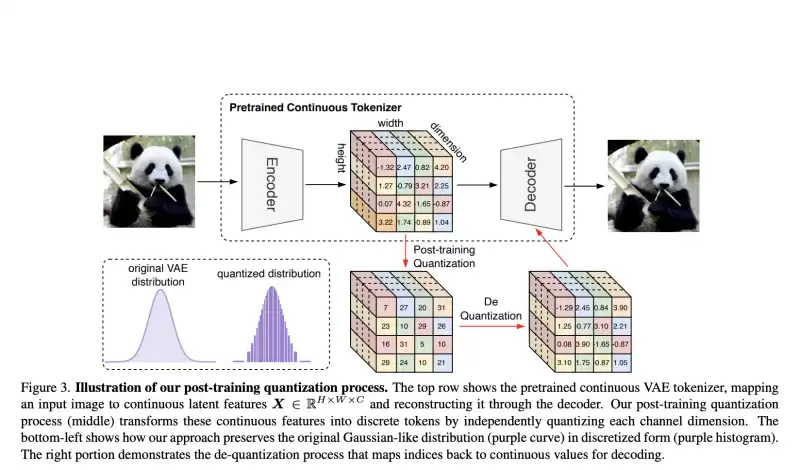
To bridge this critical gap between continuous and discrete token representations in visual generation, researchers from the University of Hong Kong, ByteDance Seed, Ecole Polytechnique, and Peking University propose TokenBridge. It aims to utilize the strong representation capacity of continuous tokens while maintaining the modeling simplicity of discrete tokens. TokenBridge decouples the discretization process from initial tokenizer training by introducing a novel post-training quantization technique. Moreover, it implements a unique dimension-wise quantization strategy that independently discretizes each feature dimension, complemented by a lightweight autoregressive prediction mechanism. It efficiently manages the expanded token space while preserving high-quality visual generation capabilities.
TokenBridge introduces a training-free dimension-wise quantization technique that operates independently on each feature channel, effectively addressing previous token representation limitations. The approach capitalizes on two crucial properties of Variational Autoencoder features: their bounded nature due to KL constraints and near-Gaussian distribution.
The autoregressive model adopts a Transformer architecture with two primary configurations: a default L model comprising 32 blocks with 1024 width (approx 400 million parameters) for initial studies and a larger H model with 40 blocks and 1280 width (around 910 million parameters) for final evaluations. This design allows a detailed exploration of the proposed quantization strategy across different model scales.
The results demonstrate that TokenBridge outperforms traditional discrete token models, achieving superior Frechet Inception Distance (FID) with significantly fewer parameters. For instance, TokenBridge-L secures an FID of 1.76 with only 486 million parameters, contrasting with LlamaGen's 2.18 using 3.1 billion parameters. When benchmarked against continuous approaches, TokenBridge-L outperforms GIVT, achieving a FID of 1.76 versus 3.35.
The H-model configuration further validates the method's effectiveness, matching MAR-H in FID (1.55) while delivering superior Inception Score and Recall metrics with marginally fewer parameters. These results highlight TokenBridge's capability to bridge discrete and continuous token representations.
In conclusion, researchers present TokenBridge, which bridges the longstanding gap between discrete and continuous token representations. It achieves high-quality visual generation with remarkable efficiency by introducing a post-training quantization approach and dimension-wise autoregressive decomposition. The research demonstrates that discrete token approaches using standard cross-entropy loss can compete with state-of-the-art continuous methods, eliminating the need for complex distribution modeling techniques. This finding opens a promising pathway for future investigations, potentially transforming how researchers conceptualize and implement token-based visual synthesis technologies.
Check out the Paper, GitHub Page and Project. All credit for this research goes to the researchers of this project. Also, feel free to follow us on Twitter and don’t forget to join our 85k+ ML SubReddit.
Disclaimer:info@kdj.com
The information provided is not trading advice. kdj.com does not assume any responsibility for any investments made based on the information provided in this article. Cryptocurrencies are highly volatile and it is highly recommended that you invest with caution after thorough research!
If you believe that the content used on this website infringes your copyright, please contact us immediately (info@kdj.com) and we will delete it promptly.
-

- Datavecta Forges Global Community Ecosystem to Power International Growth Through Advanced SEO Strategy
- Sep 30, 2026 at 07:55 pm
- Datavecta is building a global community ecosystem to enhance international growth, leveraging advanced SEO strategies and technology-driven services for a connected intelligent trading future.
-
- Illinois Rolls Out Draft Rules for 0.2% Crypto Transaction Tax, Set for 2027
- Sep 30, 2026 at 12:05 pm
- Illinois unveils draft regulations for its upcoming 0.2% digital asset transaction tax, impacting exchanges, transfers, and custody services starting January 1, 2027. The tax applies to the gross value of transactions, not investment gains.
-
-
- Apeing Leads the Charge: Unveiling the Next 100x Crypto Watchlist and 6 Coins to Eye
- Sep 30, 2026 at 12:03 pm
- Amidst a dynamic crypto market, Apeing's presale momentum, coupled with established players like Solana and TRON, is redefining the 100x crypto narrative, offering both early-stage opportunities and proven network strength.
-
-
- OpenAI Unveils GPT-6.1 Sol and Ultrafast Tier, While AstraZeneca Invests Big in Summit Therapeutics
- Sep 30, 2026 at 08:05 am
- OpenAI rolls out GPT-6.1 Sol, offering near-Astra performance at a fraction of the cost, alongside a new 'Ultrafast' speed tier. Meanwhile, AstraZeneca makes a significant $2 billion investment in oncology firm Summit Therapeutics.
-
-
-
- Robinhood Chain Sees Surge in Perps as Spot Trading Cools Amidst Broader Market Shifts
- Sep 29, 2026 at 12:05 pm
- Robinhood Chain's trading landscape is bifurcating: perpetual futures volume is skyrocketing, while spot trading is cooling. This trend hints at a strategic shift in trader behavior on the platform.


