












 |
|
 |
|
 |
|
 |
|
 |
|
 |
|
 |
|
 |
|
 |
|
 |
|
 |
|
 |
|
 |
|
 |
|
 |
|
Cryptocurrency News Articles
Reward-Guided Speculative Decoding: A New Paradigm for Efficient LLM Inference
Feb 15, 2025 at 03:44 am
In recent years, the rapid scaling of large language models (LLMs) has led to extraordinary improvements in natural language understanding and reasoning capabilities.
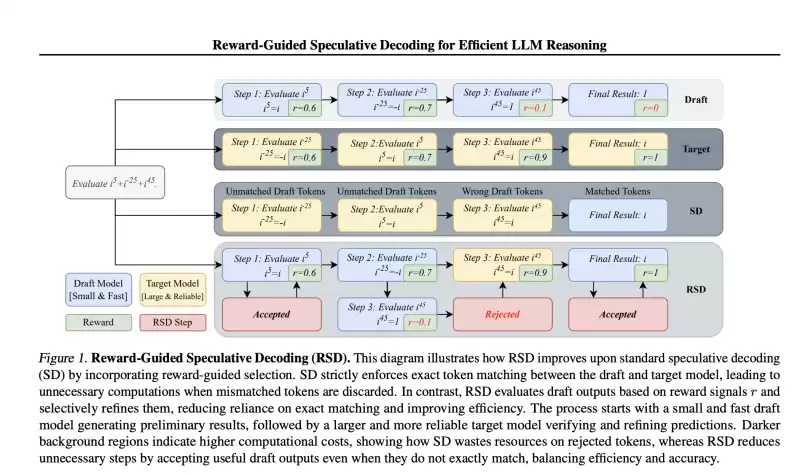
Salesforce AI Research has introduced Reward-Guided Speculative Decoding (RSD), a novel framework for efficient inference in large language models (LLMs). The approach aims to strike a balance between speed and performance, addressing the computational challenges faced by LLMs during sequential token generation.
At a Glance
RSD combines a fast, lightweight “draft” model with a more robust “target” model.
A process reward model (PRM) evaluates draft model outputs in real time.
RSD introduces a controlled bias to prioritize high-reward outputs.
The approach enables “biased acceleration” and outperforms speculative decoding.
RSD achieves up to 4.4× faster inference and +3.5 average accuracy improvement.
Technical Details and Benefits of RSD
Delving into the technical aspects, RSD operates by integrating two models in a sequential yet collaborative manner. Initially, the draft model produces candidate tokens or reasoning steps at a low computational cost. Each candidate is then evaluated using a reward function, which acts as a quality gate. If a candidate token’s reward exceeds a predetermined threshold, the output is accepted; if not, the system calls upon the more computationally intensive target model to generate a refined token. This process is guided by a weighting function—typically a binary step function—that adjusts the reliance on the draft versus the target model.
The dynamic quality control afforded by the process reward model (PRM) ensures that only the most promising outputs bypass the target model, thereby saving on computation. One of the standout benefits of this approach is “biased acceleration,” where the controlled bias is not a detriment but rather a strategic choice to prioritize high-reward outcomes. This results in two key benefits: first, the overall inference process can be up to 4.4× faster compared to running the target model alone; second, it often yields a +3.5 average accuracy improvement over conventional parallel decoding baselines. In essence, RSD harmonizes efficiency with accuracy—allowing for a substantial reduction in the number of floating-point operations (FLOPs) while still delivering outputs that meet or even exceed the performance of the target model. The theoretical underpinnings and algorithmic details, such as the mixture distribution defined by PRSD and the adaptive acceptance criterion, provide a robust framework for practical deployment in diverse reasoning tasks.
Insights
The empirical validation of RSD is compelling. Experiments detailed in the paper demonstrate that, on challenging benchmarks such as GSM8K, MATH50K, OlympiadBench, and GPQA, RSD consistently delivers superior performance. For instance, on the MATH500 benchmark—a dataset designed to test mathematical reasoning—RSD achieved an accuracy of 88.0 when configured with a 72B target model and a 7B PRM, compared to 85.6 for the target model running alone. Not only does this configuration reduce the computational load by nearly 4.4× fewer FLOPs, but it also enhances reasoning accuracy. The results underscore the potential of RSD to outperform traditional methods, such as speculative decoding (SD) and even advanced search-based techniques like beam search or Best-of-N strategies.
Conclusion: A New Paradigm for Efficient LLM Inference
In conclusion, Reward-Guided Speculative Decoding (RSD) marks a significant milestone in the quest for more efficient LLM inference. By intelligently combining a lightweight draft model with a powerful target model, and by introducing a reward-based acceptance criterion, RSD effectively addresses the dual challenges of computational cost and output quality. The innovative approach of biased acceleration allows the system to selectively bypass expensive computations for high-reward outputs, thereby streamlining the inference process. The dynamic quality control mechanism—anchored by a process reward model—ensures that computational resources are allocated judiciously, engaging the target model only when necessary. With empirical results showing up to 4.4× faster inference and an average accuracy improvement of +3.5 over traditional methods, RSD not only paves the way for more scalable LLM deployments but also sets a new standard in the design of hybrid decoding frameworks.
Check out the Paper and GitHub Page. All credit for this research goes to the researchers of this project. Also, feel free to follow us on Twitter and don’t forget to join our 75k+ ML SubReddit.
? Recommended Open-Source AI Platform: ‘IntellAgent is a An Open-Source Multi-Agent Framework to Evaluate Complex Conversational AI System’ (Promoted)
Disclaimer:info@kdj.com
The information provided is not trading advice. kdj.com does not assume any responsibility for any investments made based on the information provided in this article. Cryptocurrencies are highly volatile and it is highly recommended that you invest with caution after thorough research!
If you believe that the content used on this website infringes your copyright, please contact us immediately (info@kdj.com) and we will delete it promptly.
-

- Ripple RLUSD Circulation Hits $2.4 Billion: A Closer Look at the Stablecoin's Trajectory
- Sep 13, 2026 at 04:05 am
- Ripple's RLUSD stablecoin circulation has reached a reported $2.4 billion, a significant milestone, though discerning its true impact requires a nuanced understanding of metrics and market dynamics.
-
-
- Reform UK's Crypto Funding: A Deep Dive into the £72M Donation and Its Ripple Effects
- Sep 13, 2026 at 03:55 am
- Reform UK has secured a colossal £72 million in crypto-linked donations, sparking debate over campaign finance and the growing influence of digital assets in British politics. This unprecedented funding reshapes the electoral landscape and intensifies regulatory scrutiny.
-
- Teucrium Inverse XRP ETF Sets October 11th Effective Date: What Investors Need to Know About the ETF Launch Date
- Sep 13, 2026 at 03:45 am
- Teucrium's inverse XRP ETF has a new proposed effective date of October 11, 2026. Here's a breakdown of what this means for investors and the broader ETF landscape.
-
- CPEN Network Ink Token: A Deep Dive into Mobile Mining, Tokenomics, and Its Evolving Legacy
- Sep 12, 2026 at 04:05 pm
- Explore the journey of CPEN Network Ink Token, from its innovative mobile mining approach and unique tokenomics to its planned succession by HATN, reflecting the dynamic nature of crypto projects.
-
- XRP Investors Face Critical Decision Amidst Market Uncertainty and Key Economic Events
- Sep 12, 2026 at 04:05 pm
- XRP investors are at a crossroads, weighing critical investment decisions as market volatility decreases and major economic events loom. Analysis of recent trends and upcoming catalysts provides key insights.
-
-
-


