









 |
|
 |
|
 |
|
 |
|
 |
|
 |
|
 |
|
 |
|
 |
|
 |
|
 |
|
 |
|
 |
|
 |
|
 |
|
Cryptocurrency News Articles
Fractal Network: The Unifying Force of Bitcoin Programmability
Jun 27, 2024 at 10:52 pm
Bitcoin-native innovations like Ordinals, BRC20, Runes, and Layer-2-oriented innovations are ready. Fractal enters the scene, working as a unifying/culminating force.
Bitcoin has remained the top cryptocurrency with a market cap of over $1.2 trillion, which is roughly 55% of crypto’s entire market cap at the time of writing.
However, since BTC holders can do very little with their coins (basically send, receive, and/or hold), 99.8% of this huge market cap is lying idle. Conversely, BTC’s utilization rate is a meager 0.2% vs. 17% for ETH, 14% for Polygon and about 4-6% for Avalanche, Solana, etc.
But thanks to Ordinals, the doors to innovations that’ll improve Bitcoin utility slammed open in 2023. It showed that creating NFTs and other non-fungible assets is possible on the world’s most decentralized and secure L1 blockchain.
This marked a giant leap towards making BTC more usable, practically relevant, and valuable beyond price actions for the masses. Over 67 million ordinals have been inscribed in the past year, testifying its demand and PMF.
More importantly, Ordinals sparked progressive developments like BRC20, Runes, etc. and set the ground for the next wave of Bitcoin’s adoption drivers. Projects like Fractal Network are harnessing this shift and building user-centric solutions to enhance Bitcoin programmability.
As a member of the UTXO Alliance and Bitcoin community, solving instrumental questions is Fractal’s core mission. It rises above L2 vs. Ordinals/Runes narratives and takes a holistic approach to make DeFi more secure, reliable, and accessible.
Programmability is Bitcoin’s next meta
Ordinals gave new vigor to Bitcoin-native innovators by bringing NFTs to the network and shining the light on future possibilities. While at a more subtle and short-term level, it offered a much-needed lifeline to BTC miners pre and post-Halving.
It’s clear that Bitcoin is nearing that level of maturity where a majority of the miners’ income will come from fees, as Satoshi had mentioned in the white paper.
Ordinals are set to create a positive feedback loop in this context. More utility means more transactions, more fees, more revenue for miners, and more security. The instrument has generated about 6.8K BTC in fees (~$441 million) so far, which mainly went to miners.
Nevertheless, although NFTs are great for capturing retail mindshare, they’re not enough from aadoption and value creation perspective. Bitcoin-based NFTs showed the way but to actually expand the network’s utility, we need genuine programmability.
Runes have risen to this occasion, potentially doing for Bitcoin what ERC20 did for Ethereum — enabling fungible tokens. The fact that Runes have consistently dominated over BRC20s signals the community’s demand for deeper, more utility-driven Bitcoin innovations than NFTs or collectibles.
Programmability is the next logical stage in Bitcoin’s evolution and there’s growing consensus among devs in this regard. With Ordinals, BRC20, Runes, and Layer-2-oriented innovations like Nervos’s RGB++ protocol, the individual tools are quite ready.
That’s where Fractal — a multi-layer solution running 2 UTXO layers (a layer 1 and a layer 2) as well as an EVM layer 1 — enters the scene, working as a unifying/culminating force for the above developments.
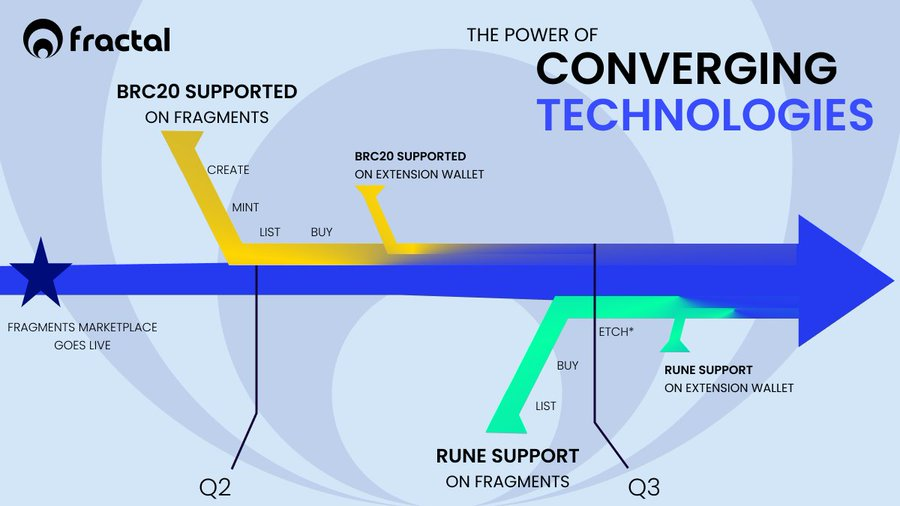
Unleashing the power of converging tech
We learned from Ethereum’s journey that fragmentation is not welcome. Diversification is, though, and we need a vibrant suite of solutions flourishing in any ecosystem, especially Bitcoin.
Enabling varied Bitcoin-powered dApps and tokens while avoiding walled gardens is Fractal’s key purpose. So the team has tapped into all the major developments in Bitcoin programmability to build a user-friendly and utility-rich platform.
That too, while causing minimal disruptions to Bitcoin’s existing architecture and value propositions. It’s the mark of true grassroots innovation for community empowerment.
Contrary to account-based models that foster centralization, Fractal’s UTXO framework brings back real decentralization. It also simplifies state management while efficient parallel processing boosts scalability.
The combination of Bitcoin-grade encryptions and advanced zero-knowledge implementations ensures that users don’t sacrifice privacy for transparency. They can have both.
Fractal’s unique framework allows users to seamlessly move between its UTXO and EVM Layer 1s via the Confluence Bridge. This unlocks staking and bridging functionalities compatible with the network’s native $FRA token.
Building on this infra, the team launched Fragments, a novel launchpad for Inscriptions and BRC20s. It’ll boost programmability by letting users deploy, mint, trade, list, and buy inscriptions at minimal costs
Disclaimer:info@kdj.com
The information provided is not trading advice. kdj.com does not assume any responsibility for any investments made based on the information provided in this article. Cryptocurrencies are highly volatile and it is highly recommended that you invest with caution after thorough research!
If you believe that the content used on this website infringes your copyright, please contact us immediately (info@kdj.com) and we will delete it promptly.
-

- Pepeto, XRP, and SHIB: Navigating the Next Wave in Crypto's Dynamic Landscape
- Sep 24, 2026 at 04:05 am
- Amidst Bitcoin's resurgence, investors are eyeing Pepeto, XRP, and SHIB. Pepeto stands out with its live trading platform and projected 100x-300x gains, while XRP and SHIB present more measured growth opportunities, highlighting a shift towards innovative presales for substantial returns.
-
-
- Blockchain.com and NYSE Forge Ahead in Tokenized Securities with Global 24/7 Trading Vision
- Sep 24, 2026 at 04:05 am
- Blockchain.com and the NYSE are collaborating to bring tokenized US equities and ETFs to a global crypto-native audience, pushing the boundaries of traditional finance and digital assets.
-
- Circle's Stablecoin Chain, USDC, and Stablecoin Chain Dynamics: A New Era Dawns
- Sep 24, 2026 at 04:05 am
- Circle's new stablecoin chain, Arc, is making waves with rapid adoption and significant transaction volumes. Meanwhile, the CCTP faces sunsetting, prompting a shift in USDC bridge technology. Binance deepens its ties with Circle, investing $100M to boost USDC in emerging markets.
-
-
-
- Cardano's Ninth Anniversary: A Look Back and a Leap Forward into the Dijkstra Era
- Sep 24, 2026 at 04:05 am
- Cardano celebrates nine years of pioneering blockchain innovation, reflecting on its journey from a research-driven concept to a fully self-governing ecosystem, and setting sights on a scalable future with the ambitious Dijkstra era upgrades.
-
-


