





![Crypto Otaku - CRYPTO CHAOS! 80K BITCOIN! WAR OVER? AI ENDS HUMANITY!? ANTHROPIC! [Episode 928]](/uploads/2026/10/26/cryptocurrencies-news/videos/origin_6adf589ee082e_image_500_375.webp "Crypto Otaku - CRYPTO CHAOS! 80K BITCOIN! WAR OVER? AI ENDS HUMANITY!? ANTHROPIC! [Episode 928]")


![Fighting Sleep Itself [Welcome to Elderfield Part 3]](/uploads/2026/10/26/cryptocurrencies-news/videos/origin_6adf5d41b9fa6_image_500_375.webp "Fighting Sleep Itself [Welcome to Elderfield Part 3]")






 |
|
 |
|
 |
|
 |
|
 |
|
 |
|
 |
|
 |
|
 |
|
 |
|
 |
|
 |
|
 |
|
 |
|
 |
|
Cryptocurrency News Articles
Chameleon: A Revolutionary Model for Seamless Multimodal Document Creation
May 18, 2024 at 03:04 pm
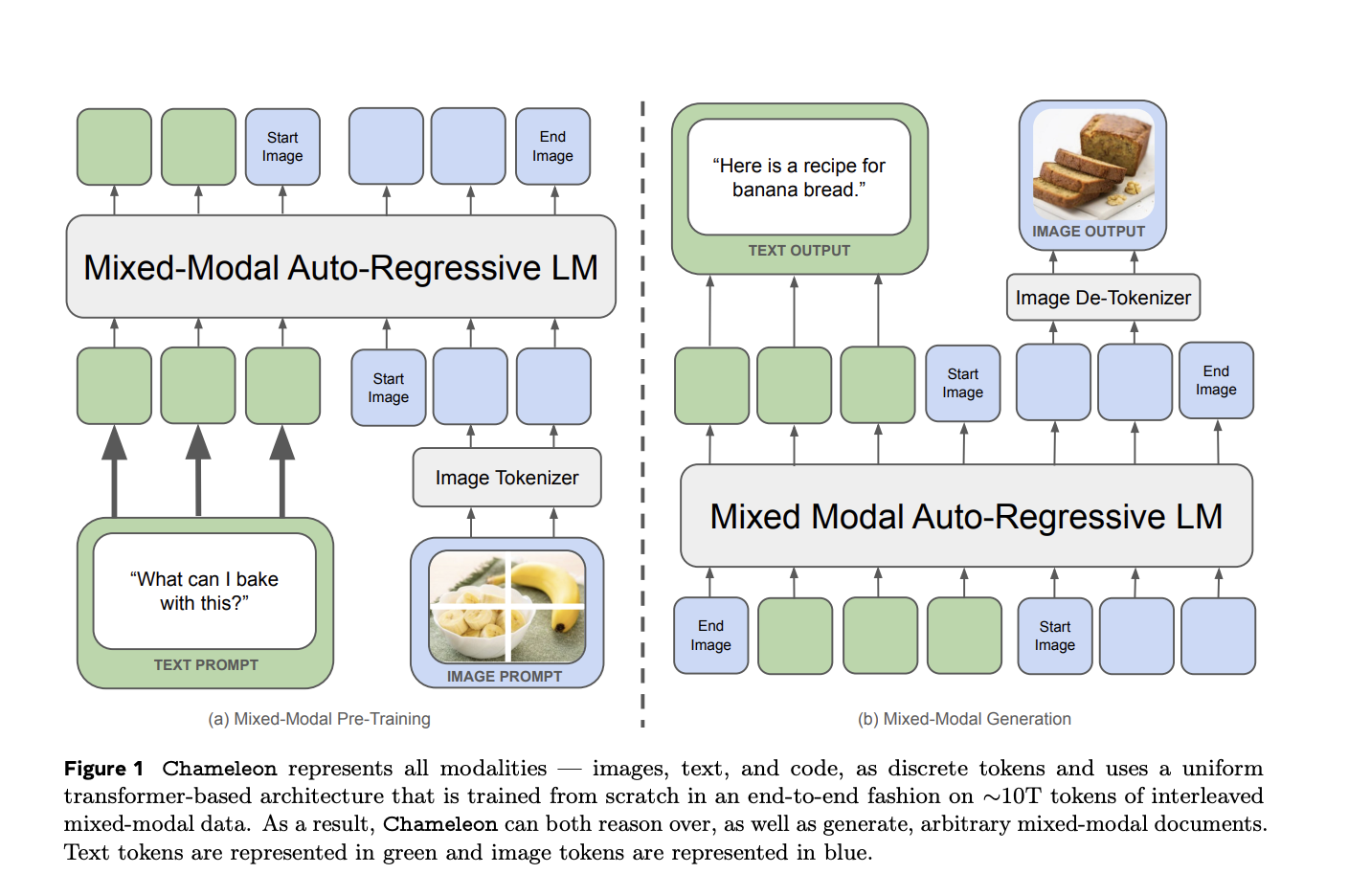
Meta researchers have developed Chameleon, a multimodal foundation model that seamlessly integrates image and text sequences. Unlike traditional models that segregate modalities, Chameleon's unified architecture tokenizes images like text, enabling comprehensive document modeling and interleaved reasoning across modalities. To address optimization challenges in this early fusion approach, the researchers introduced architectural enhancements and training techniques, resulting in successful training on Meta's large-scale dataset. Chameleon's evaluation demonstrates competitive performance in text-only tasks, outperforming LLaMa-2 in commonsense reasoning and math. In image-related tasks, it excels in image captioning and visual question answering, surpassing or matching larger models with fewer shots.
Chameleon: A Unified Foundation Model for Seamless Multimodal Document Modeling
Recent multimodal foundation models have revolutionized the field of artificial intelligence, enabling impressive advancements in tasks such as natural language processing, image recognition, and question answering. However, these models often treat different modalities separately, employing specific encoders or decoders for each. This approach inherently limits their ability to effectively fuse information across modalities and produce comprehensive multimodal documents that seamlessly integrate diverse sequences of images and text.
Meta researchers have addressed this challenge by introducing Chameleon, a groundbreaking mixed-modal foundation model designed to facilitate seamless reasoning and generation with interleaved textual and image sequences. Unlike traditional models, Chameleon employs a unified architecture that treats both modalities equally by tokenizing images akin to text. This approach, termed early fusion, allows for seamless flow of information across modalities but also presents unique optimization challenges.
To overcome these challenges, the researchers have incorporated architectural enhancements and innovative training techniques into Chameleon's design. By adapting transformer architecture and fine-tuning strategies, they have laid the foundation for a model capable of addressing the complexities of multimodal document modeling.
To capture the visual information effectively, they developed a novel image tokenizer that encodes high-resolution 512 × 512 images into 1024 tokens from an 8192-codebook. This tokenization process ensures that images are represented in a manner compatible with the text tokens, facilitating seamless reasoning across modalities. They further refined their tokenizer by introducing a BPE tokenizer with a 65,536-vocabulary, including image tokens, trained using the sentencepiece library. This enhanced tokenizer improved the model's performance and stability.
During training, they employed QK-Norm, dropout, and z-loss regularization techniques to address stability issues. Additionally, they leveraged Meta's RSC platform for efficient and scalable training. Inference in Chameleon is streamlined using PyTorch and xformers, supporting both streaming and non-streaming modes with token masking for conditional logic.
To enhance model capabilities and safety, Chameleon underwent a rigorous alignment stage, undergoing fine-tuning on diverse datasets encompassing Text, Code, Visual Chat, and Safety. This comprehensive training regimen aimed to improve the model's generalizability and mitigate potential risks. They curated high-quality images for Image Generation using an aesthetic classifier, ensuring that the model generates visually appealing and relevant images.
Supervised Fine-Tuning (SFT) played a crucial role in Chameleon's training process. By balancing data across modalities and employing a cosine learning rate schedule with a weight decay of 0.1, the researchers optimized the model's performance exclusively based on answer prompts. Dropout of 0.05 and z-loss regularization further enhanced the model's stability. Images in prompts were resized with border padding, while those in answers underwent center-cropping for optimal image generation quality.
Chameleon's versatility extends beyond its core multimodal capabilities, as evidenced by its strong performance on various text-only tasks. The model achieved competitive results on commonsense reasoning and math tasks, surpassing LLaMa-2 on many benchmarks. This improvement can be attributed to Chameleon's robust pre-training and the inclusion of code data in its training regimen.
In image-to-text tasks, Chameleon excelled in image captioning, matching or surpassing larger models like Flamingo-80B and IDEFICS-80B with fewer shots. Its performance in visual question answering (VQA) approached that of top models, even though LLaMa-1.5 slightly outperformed VQA-v2.
Overall, Chameleon demonstrates remarkable versatility and efficiency across different tasks, requiring fewer training examples and smaller model sizes compared to its counterparts.
In summary, Chameleon is a token-based model that seamlessly integrates image and text tokens, enabling superior performance in vision-language tasks. Its unified architecture facilitates joint reasoning over modalities, surpassing late-fusion models like Flamingo and IDEFICS in image captioning and visual question answering. Chameleon's early-fusion approach introduces novel techniques for stable training, addressing scalability challenges faced by previous multimodal models. It opens up new possibilities for multimodal interaction, as demonstrated by its strong performance on mixed-modal open-ended QA benchmarks.
This groundbreaking research paves the way for the development of even more advanced multimodal models capable of handling complex tasks and producing highly coherent and informative content. Researchers, practitioners, and industry leaders alike eagerly anticipate the transformative potential of Chameleon and its potential impact on the future of AI-driven multimodal applications.
Disclaimer:info@kdj.com
The information provided is not trading advice. kdj.com does not assume any responsibility for any investments made based on the information provided in this article. Cryptocurrencies are highly volatile and it is highly recommended that you invest with caution after thorough research!
If you believe that the content used on this website infringes your copyright, please contact us immediately (info@kdj.com) and we will delete it promptly.
-

-
- Keystone Breach: Customer Data Leak Ignites Hardware Wallet Security Concerns
- Oct 26, 2026 at 11:55 am
- Keystone's recent data breach, exposing customer shipping information, underscores escalating security risks for crypto hardware wallet users and sparks critical questions about data retention and user safety.
-
-
-
- AI Agents, ETH Glamsterdam Fork, and the 'Steal My Bitcoin' Saga: A Deep Dive into Crypto's Evolving Security Landscape
- Oct 26, 2026 at 07:55 am
- Ethereum's Glamsterdam hard fork faces delays, while AI agents revolutionize vulnerability scanning, and the 'Steal My Bitcoin' site tests PHP2Shell resilience, highlighting crypto's dynamic security evolution.
-
-
-
- AI Agents, ETH Glamsterdam Fork, and the 'Steal My Bitcoin' Saga: A New York Minute on Crypto Security
- Oct 26, 2026 at 07:15 am
- AI agents are stepping up to secure crypto, as seen with the ETH Glamsterdam fork's rescue, while the 'Steal My Bitcoin' challenge tests an old vulnerability, highlighting a dynamic era for digital asset safety.
-
- GMO Trading Cloud Breach Raises Server Risk Concerns, Echoing Past Data Incidents
- Oct 26, 2026 at 07:15 am
- A significant server risk event at GMO Trading Cloud, potentially affecting 26,739 servers, highlights ongoing data breach vulnerabilities in the financial tech sector. This news follows similar incidents, underscoring the need for robust security.


