











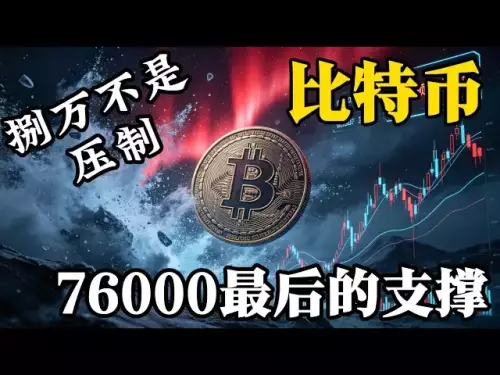


![There will be a violent washout of Bitcoin next. Don't buy the bottom too early. It won't stretch quickly in the short term. What you need to do now is to wait patiently for a good buying position, keep your bullets, and don't get hung up on it. When you buy the bottom, you will run out of bullets! Bitcoin market analysis [Issue 725]](/uploads/2026/08/23/cryptocurrencies-news/videos/origin_6a8afd33c749f_image_500_375.webp "There will be a violent washout of Bitcoin next. Don't buy the bottom too early. It won't stretch quickly in the short term. What you need to do now is to wait patiently for a good buying position, keep your bullets, and don't get hung up on it. When you buy the bottom, you will run out of bullets! Bitcoin market analysis [Issue 725]")






-
 bitcoin
 $76009.435780 USD
-1.53% - ethereum
$2375.311573 USD
-2.24% - tether
$0.999942 USD
0.01% - bnb
$682.047535 USD
-2.01% - xrp
$1.441787 USD
-5.55% - usd-coin
$1.000052 USD
0.00% - solana
$92.061879 USD
-1.80% - tron
$0.342038 USD
-0.93% - hyperliquid
$77.587999 USD
-1.41% - dogecoin
$0.089327 USD
-2.08% - zcash
$782.134934 USD
-0.71% - unus-sed-leo
$9.484522 USD
0.92% - chainlink
$11.132242 USD
-5.45% - monero
$431.110612 USD
0.39% - cardano
$0.214545 USD
-7.12%











OKX Futures Trading: A Complete Guide from Beginner to Pro.
OKX futures let traders speculate on crypto prices with leverage up to 125x, using coin or USDT margin, and offer tools for advanced strategies like arbitrage and scalping.
Dec 07, 2025 at 06:39 am
Understanding the Basics of OKX Futures
1. OKX futures allow traders to speculate on the future price of cryptocurrencies such as Bitcoin and Ethereum without owning the underlying asset. Contracts are standardized, meaning each one represents a specific amount of the digital currency and expires on a predetermined date.
2. There are two main types of futures contracts available on OKX: Coin-margined and USDT-margined. Coin-margined contracts use the cryptocurrency itself as collateral, while USDT-margined ones use stablecoins, offering more predictable value during volatile market swings.
3. Leverage is a core feature, enabling users to control large positions with relatively small capital. OKX supports leverage up to 125x depending on the contract and asset, though higher leverage increases both potential gains and risks significantly.
4. The platform offers both isolated and cross margin modes. Isolated margin limits risk to the allocated funds for a single position, whereas cross margin uses the entire account balance as collateral, increasing exposure but also liquidation protection.
5. Traders can go long (buy) if they expect prices to rise or short (sell) if they anticipate a decline. Settlement occurs either through cash or physical delivery, depending on the contract type, with most perpetual swaps settling in cash.
Navigating the OKX Trading Interface
1. Upon logging into OKX, users access the futures section where real-time order books, price charts, and open interest data are displayed. The interface supports multiple charting tools powered by TradingView, allowing technical analysis directly within the platform.
2. Order types include limit, market, stop-limit, and take-profit orders. Each serves different strategic purposes—limit orders execute at specified prices, while market orders fill immediately at current rates.
3. The depth chart shows buy and sell walls, helping traders assess liquidity and potential support/resistance zones. This information is crucial when placing large orders to avoid significant slippage.
4. Position management tools let users adjust leverage, set stop-losses, and monitor unrealized PnL in real time. These features help maintain discipline and prevent emotional decision-making during fast-moving markets.
5. Risk indicators such as liquidation price and maintenance margin are prominently displayed. Understanding these values helps traders avoid unexpected position closures due to adverse price movements.
Strategies Used by Advanced OKX Futures Traders
1. Arbitrage between spot and futures markets is common. When futures trade at a premium (contango) or discount (backwardation), traders exploit the difference by going long on one market and short on the other.
2. Basis trading involves analyzing the gap between the futures price and the spot price. A widening basis may signal bullish sentiment, prompting traders to enter positions before expected convergence.
3. Scalping strategies rely on high-frequency trades using tight bid-ask spreads. Traders using this method often employ bots to automate entries and exits based on micro-price fluctuations.
4. Trend-following approaches use moving averages, RSI, and MACD to identify momentum shifts. Entries are timed after confirmed breakouts, with trailing stops protecting profits during sustained moves.
p>5. Mean reversion tactics assume prices will return to historical averages after sharp deviations. This works well in range-bound markets, especially when combined with volume profile analysis to detect key reversal levels.
Frequently Asked Questions
What is the difference between perpetual and quarterly futures on OKX?Perpetual futures do not have an expiration date and rely on funding rates to stay aligned with spot prices. Quarterly futures expire every three months and settle at the end of the term based on an index price.
How does funding rate work in OKX perpetual swaps?Funding rates are periodic payments exchanged between long and short positions to anchor the contract price to the underlying spot market. If rates are positive, longs pay shorts; if negative, shorts pay longs.
Can I trade OKX futures anonymously?No, KYC verification is required to access futures trading on OKX. This complies with regulatory standards and ensures account security, especially given the leveraged nature of these products.
What happens during a liquidation event?When a position’s margin falls below the maintenance threshold, OKX automatically closes it to prevent further losses. Partial or full liquidation depends on the mode used—isolated margin typically results in total closure of that specific position.
Disclaimer:info@kdj.com
The information provided is not trading advice. kdj.com does not assume any responsibility for any investments made based on the information provided in this article. Cryptocurrencies are highly volatile and it is highly recommended that you invest with caution after thorough research!
If you believe that the content used on this website infringes your copyright, please contact us immediately (info@kdj.com) and we will delete it promptly.





- Bitcoin, eCash Fork, and Airdrop Dynamics: A Deep Dive into Crypto's Latest Controversies
- 2026-05-03 12:55:01
- Consensus 2026 Miami: Web3, Blockchain, Cryptocurrency, NFTs, Metaverse, Conference, May 5th — Where Wall Street Meets the Digital Frontier
- 2026-05-02 12:45:01
- Fed Holds Rates Steady, Triggering Bitcoin Price Drop Amidst Geopolitical Tensions
- 2026-05-01 06:45:01
- Bitcoin Miners Electrify the Grid: Ohio Gas Plant Acquisition Powers Up a New Era for Digital Gold
- 2026-05-01 00:45:01
- MegaETH's MEGA Token Hits the Big Apple: Setting New Performance Benchmarks for Real-Time Blockchain
- 2026-05-01 00:55:01
- Solana's Slippery Slope: Price Prediction Points to Resistance Loss and Potential Further Drops
- 2026-05-01 06:45:01
Related knowledge
How to Manage Copy Trading Risk on Bybit? Complete BTC and ETH Copy Trading Guide
Aug 20,2026 at 03:39pm
Understanding Copy Trading Mechanics on Bybit1. Copy trading on Bybit operates through the Unified Trading Account, where follower balances are automa...
How to Start Futures Copy Trading on Binance? Complete Beginner Setup Guide
Aug 18,2026 at 08:19pm
Understanding Futures Copy Trading Mechanics1. Futures copy trading allows users to automatically replicate the open positions and trade executions of...
How to Trade ETH with USDC on OKX? Step-by-Step Ethereum Trading Tutorial
Aug 21,2026 at 08:19pm
Account Setup and Verification1. Register an OKX account using a valid email address or phone number. 2. Complete identity verification by uploading g...
How to Transfer SOL from Bitget to Binance? Complete Solana Withdrawal Guide
Aug 22,2026 at 11:00am
Understanding SOL Network Compatibility1. Solana’s native token SOL operates exclusively on the Solana blockchain, which uses a unique RPC infrastruct...
How to Withdraw USDT from MEXC? Step-by-Step Stablecoin Withdrawal Guide
Aug 21,2026 at 09:00pm
Accessing the Withdrawal Interface1. Log in to your MEXC account using verified credentials and two-factor authentication. 2. Navigate to the “Assets”...
How to Check ETH Futures Volume on Bybit? Step-by-Step Trading Data Tutorial
Aug 22,2026 at 02:40am
Market Volatility Patterns1. Bitcoin price swings often exceed 5% within a single trading session during periods of high liquidity imbalance. 2. Altco...
How to Manage Copy Trading Risk on Bybit? Complete BTC and ETH Copy Trading Guide
Aug 20,2026 at 03:39pm
Understanding Copy Trading Mechanics on Bybit1. Copy trading on Bybit operates through the Unified Trading Account, where follower balances are automa...
How to Start Futures Copy Trading on Binance? Complete Beginner Setup Guide
Aug 18,2026 at 08:19pm
Understanding Futures Copy Trading Mechanics1. Futures copy trading allows users to automatically replicate the open positions and trade executions of...
How to Trade ETH with USDC on OKX? Step-by-Step Ethereum Trading Tutorial
Aug 21,2026 at 08:19pm
Account Setup and Verification1. Register an OKX account using a valid email address or phone number. 2. Complete identity verification by uploading g...
How to Transfer SOL from Bitget to Binance? Complete Solana Withdrawal Guide
Aug 22,2026 at 11:00am
Understanding SOL Network Compatibility1. Solana’s native token SOL operates exclusively on the Solana blockchain, which uses a unique RPC infrastruct...
How to Withdraw USDT from MEXC? Step-by-Step Stablecoin Withdrawal Guide
Aug 21,2026 at 09:00pm
Accessing the Withdrawal Interface1. Log in to your MEXC account using verified credentials and two-factor authentication. 2. Navigate to the “Assets”...
How to Check ETH Futures Volume on Bybit? Step-by-Step Trading Data Tutorial
Aug 22,2026 at 02:40am
Market Volatility Patterns1. Bitcoin price swings often exceed 5% within a single trading session during periods of high liquidity imbalance. 2. Altco...
See all articles


