











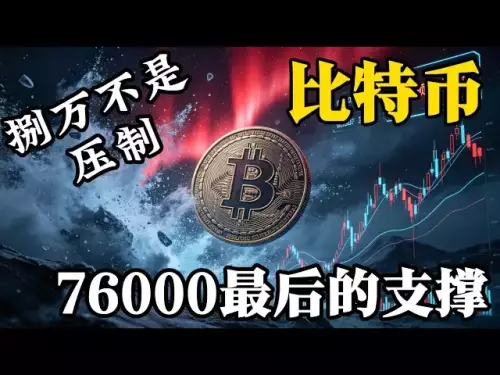


![There will be a violent washout of Bitcoin next. Don't buy the bottom too early. It won't stretch quickly in the short term. What you need to do now is to wait patiently for a good buying position, keep your bullets, and don't get hung up on it. When you buy the bottom, you will run out of bullets! Bitcoin market analysis [Issue 725]](/uploads/2026/08/23/cryptocurrencies-news/videos/origin_6a8afd33c749f_image_500_375.webp "There will be a violent washout of Bitcoin next. Don't buy the bottom too early. It won't stretch quickly in the short term. What you need to do now is to wait patiently for a good buying position, keep your bullets, and don't get hung up on it. When you buy the bottom, you will run out of bullets! Bitcoin market analysis [Issue 725]")






-
 bitcoin
 $76009.435780 USD
-1.53% - ethereum
$2375.311573 USD
-2.24% - tether
$0.999942 USD
0.01% - bnb
$682.047535 USD
-2.01% - xrp
$1.441787 USD
-5.55% - usd-coin
$1.000052 USD
0.00% - solana
$92.061879 USD
-1.80% - tron
$0.342038 USD
-0.93% - hyperliquid
$77.587999 USD
-1.41% - dogecoin
$0.089327 USD
-2.08% - zcash
$782.134934 USD
-0.71% - unus-sed-leo
$9.484522 USD
0.92% - chainlink
$11.132242 USD
-5.45% - monero
$431.110612 USD
0.39% - cardano
$0.214545 USD
-7.12%











How does Bybit P2P trading work and is it a safe way to buy crypto?
Bybit P2P enables secure fiat-crypto trades via escrow, mandatory KYC, real-time offers, and dispute resolution—no trading fees, but counterparty and payment-method risks remain.
Dec 08, 2025 at 05:00 pm

Bybit P2P Trading Infrastructure
1. Bybit P2P operates as a peer-to-peer marketplace where users directly trade cryptocurrencies with one another using fiat currencies. The platform acts as an intermediary by holding the crypto in escrow during transaction execution.
2. Buyers and sellers list their offers specifying payment methods, price premiums, minimum and maximum trade limits, and preferred fiat currencies. These listings appear in real time on the P2P order book.
3. When a buyer initiates a trade, Bybit locks the seller’s cryptocurrency in its secure smart escrow contract. Funds remain inaccessible to either party until both confirm completion.
4. The buyer transfers fiat to the seller via the agreed-upon method—bank transfer, e-wallet, or mobile payment—and uploads proof of payment within the Bybit interface.
5. Upon verifying the receipt, the seller clicks “Confirm Receipt”, triggering automatic release of the crypto from escrow to the buyer’s Bybit wallet.
Security Mechanisms Embedded in Bybit P2P
1. All P2P counterparties undergo mandatory KYC verification before listing offers or initiating trades.
2. Escrow protection ensures neither party can withdraw funds or assets prematurely—crypto stays frozen until fiat confirmation is validated.
3. Dispute resolution is managed by trained Bybit mediators who review chat logs, payment evidence, and transaction timestamps to determine rightful asset allocation.
4. Trade history, ratings, and response rates are publicly visible for each user, allowing participants to assess reliability before engaging.
5. Two-factor authentication (2FA) is enforced for all wallet actions, including P2P fund releases and profile modifications.
Risks Associated With Bybit P2P Transactions
1. Counterparty risk persists despite safeguards—delays in fiat settlement, false payment claims, or refusal to confirm receipt may trigger disputes requiring manual intervention.
2. Payment method limitations introduce friction; certain banks block crypto-related transfers, leading to chargebacks or delayed confirmations that stall escrow release.
3. Regional regulatory variance affects availability—some jurisdictions prohibit direct fiat-to-crypto on-ramps, restricting access to specific payment rails or limiting user eligibility.
4. Phishing attempts targeting P2P users increase during high-volatility periods, often impersonating official Bybit support channels to extract login credentials or 2FA codes.
5. Transaction reversibility depends entirely on the underlying payment network—wire transfers are irreversible, while some e-wallets permit sender-initiated refunds outside Bybit’s control.
Verification and Trust Indicators on Bybit P2P
1. A green “Verified” badge appears next to users who have completed Level 3 KYC, including ID document submission and facial liveness checks.
2. Trade completion rate, average response time, and dispute resolution success ratio are algorithmically weighted into a public trust score.
3. Offers flagged as “Preferred Merchant” meet strict thresholds: ≥98% completion rate, ≤5-minute average response latency, and zero unresolved disputes in the last 90 days.
4. Each trade generates an immutable timestamped log visible only to involved parties and Bybit moderators, capturing every action from offer creation to final asset release.
5. Users may filter offers by “New Seller” status or “Top Rated” designation to align with personal risk tolerance and experience level.
Frequently Asked Questions
Q: Can I cancel a P2P trade after initiating it but before payment confirmation?A: Yes, buyers may cancel pending orders before uploading payment proof. Sellers may withdraw offers at any time unless already accepted by a buyer.
Q: What happens if a seller refuses to release crypto after receiving fiat?A: The buyer can open a dispute within 15 minutes of marking payment as complete. Bybit mediators will request evidence and typically resolve within 24 hours.
Q: Are there fees for using Bybit P2P?A: Bybit does not charge trading fees for P2P transactions. However, third-party payment processors or banks may apply their own charges, which are borne by the user initiating the transfer.
Q: Does Bybit P2P support cryptocurrency withdrawals to external wallets during an active trade?A: No. All crypto involved in P2P trades remains locked in escrow until the transaction concludes. External wallet transfers are disabled for balances under active P2P contracts.
Disclaimer:info@kdj.com
The information provided is not trading advice. kdj.com does not assume any responsibility for any investments made based on the information provided in this article. Cryptocurrencies are highly volatile and it is highly recommended that you invest with caution after thorough research!
If you believe that the content used on this website infringes your copyright, please contact us immediately (info@kdj.com) and we will delete it promptly.






- Bitcoin, eCash Fork, and Airdrop Dynamics: A Deep Dive into Crypto's Latest Controversies
- 2026-05-03 12:55:01
- Consensus 2026 Miami: Web3, Blockchain, Cryptocurrency, NFTs, Metaverse, Conference, May 5th — Where Wall Street Meets the Digital Frontier
- 2026-05-02 12:45:01
- Fed Holds Rates Steady, Triggering Bitcoin Price Drop Amidst Geopolitical Tensions
- 2026-05-01 06:45:01
- Bitcoin Miners Electrify the Grid: Ohio Gas Plant Acquisition Powers Up a New Era for Digital Gold
- 2026-05-01 00:45:01
- MegaETH's MEGA Token Hits the Big Apple: Setting New Performance Benchmarks for Real-Time Blockchain
- 2026-05-01 00:55:01
- Solana's Slippery Slope: Price Prediction Points to Resistance Loss and Potential Further Drops
- 2026-05-01 06:45:01
Related knowledge
How to Manage Copy Trading Risk on Bybit? Complete BTC and ETH Copy Trading Guide
Aug 20,2026 at 03:39pm
Understanding Copy Trading Mechanics on Bybit1. Copy trading on Bybit operates through the Unified Trading Account, where follower balances are automa...
How to Start Futures Copy Trading on Binance? Complete Beginner Setup Guide
Aug 18,2026 at 08:19pm
Understanding Futures Copy Trading Mechanics1. Futures copy trading allows users to automatically replicate the open positions and trade executions of...
How to Trade ETH with USDC on OKX? Step-by-Step Ethereum Trading Tutorial
Aug 21,2026 at 08:19pm
Account Setup and Verification1. Register an OKX account using a valid email address or phone number. 2. Complete identity verification by uploading g...
How to Transfer SOL from Bitget to Binance? Complete Solana Withdrawal Guide
Aug 22,2026 at 11:00am
Understanding SOL Network Compatibility1. Solana’s native token SOL operates exclusively on the Solana blockchain, which uses a unique RPC infrastruct...
How to Withdraw USDT from MEXC? Step-by-Step Stablecoin Withdrawal Guide
Aug 21,2026 at 09:00pm
Accessing the Withdrawal Interface1. Log in to your MEXC account using verified credentials and two-factor authentication. 2. Navigate to the “Assets”...
How to Check ETH Futures Volume on Bybit? Step-by-Step Trading Data Tutorial
Aug 22,2026 at 02:40am
Market Volatility Patterns1. Bitcoin price swings often exceed 5% within a single trading session during periods of high liquidity imbalance. 2. Altco...
How to Manage Copy Trading Risk on Bybit? Complete BTC and ETH Copy Trading Guide
Aug 20,2026 at 03:39pm
Understanding Copy Trading Mechanics on Bybit1. Copy trading on Bybit operates through the Unified Trading Account, where follower balances are automa...
How to Start Futures Copy Trading on Binance? Complete Beginner Setup Guide
Aug 18,2026 at 08:19pm
Understanding Futures Copy Trading Mechanics1. Futures copy trading allows users to automatically replicate the open positions and trade executions of...
How to Trade ETH with USDC on OKX? Step-by-Step Ethereum Trading Tutorial
Aug 21,2026 at 08:19pm
Account Setup and Verification1. Register an OKX account using a valid email address or phone number. 2. Complete identity verification by uploading g...
How to Transfer SOL from Bitget to Binance? Complete Solana Withdrawal Guide
Aug 22,2026 at 11:00am
Understanding SOL Network Compatibility1. Solana’s native token SOL operates exclusively on the Solana blockchain, which uses a unique RPC infrastruct...
How to Withdraw USDT from MEXC? Step-by-Step Stablecoin Withdrawal Guide
Aug 21,2026 at 09:00pm
Accessing the Withdrawal Interface1. Log in to your MEXC account using verified credentials and two-factor authentication. 2. Navigate to the “Assets”...
How to Check ETH Futures Volume on Bybit? Step-by-Step Trading Data Tutorial
Aug 22,2026 at 02:40am
Market Volatility Patterns1. Bitcoin price swings often exceed 5% within a single trading session during periods of high liquidity imbalance. 2. Altco...
See all articles


