


















-
 bitcoin
 $77194.246092 USD
2.57% - ethereum
$2429.678583 USD
2.78% - tether
$0.999864 USD
0.03% - xrp
$1.526574 USD
16.27% - bnb
$695.975873 USD
4.67% - usd-coin
$1.000023 USD
0.01% - solana
$93.746985 USD
3.27% - tron
$0.345236 USD
2.12% - hyperliquid
$78.700141 USD
7.47% - dogecoin
$0.091220 USD
9.88% - zcash
$787.730556 USD
31.26% - chainlink
$11.774181 USD
7.30% - unus-sed-leo
$9.397771 USD
1.34% - cardano
$0.230983 USD
10.27% - monero
$429.536088 USD
3.32%











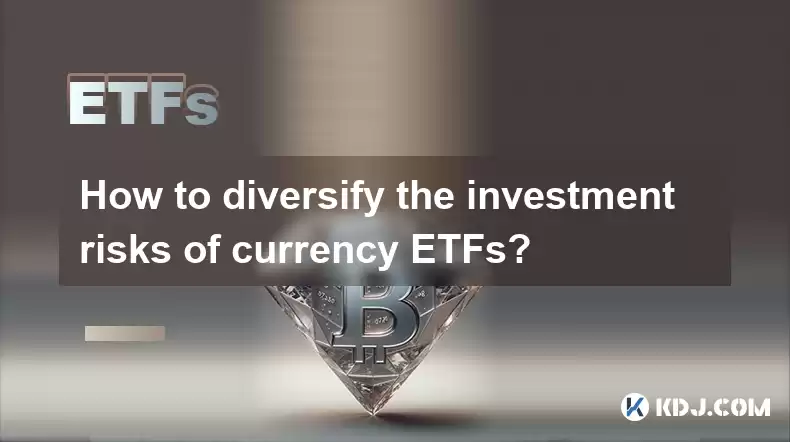
How to diversify the investment risks of currency ETFs?
By diversifying investments across multiple currencies, rebalancing, and utilizing options for hedging, investors can mitigate the risks associated with currency ETFs and enhance the potential for long-term returns.
Jan 06, 2025 at 03:59 pm
- Understand the risks associated with currency ETFs.
- Diversify investments across multiple currencies and strategies.
- Rebalance portfolio regularly to maintain diversification.
- Invest in ETFs with low correlation to each other.
- Consider using options to hedge against currency risk.
- Understand the Risks Associated with Currency ETFs:
Currency ETFs are investment funds that track the performance of a specific currency against other currencies. They offer investors exposure to foreign exchange markets without the need to trade individual currencies. However, currency ETFs carry unique risks, including currency fluctuations, interest rate changes, and geopolitical events.
- Diversify Investments Across Multiple Currencies and Strategies:
Investing in multiple currency ETFs that track different currencies helps reduce portfolio risk by spreading exposure across various markets. For instance, an investor can diversify by allocating investments in ETFs tracking the US dollar, euro, Japanese yen, and Swiss franc.
- Rebalance Portfolio Regularly to Maintain Diversification:
As currency ETFs fluctuate in value, it's essential to rebalance the portfolio regularly to maintain target allocations. This ensures that the portfolio is appropriately diversified and aligns with the investor's risk tolerance and return objectives.
- Invest in ETFs with Low Correlation to Each Other:
Currency ETFs may exhibit varying levels of correlation with each other. By investing in ETFs with low correlation, investors can minimize the impact of fluctuations in one currency on the overall portfolio. For example, ETFs tracking currencies with different economic cycles or geopolitical influences tend to have lower correlation.
- Consider Using Options to Hedge Against Currency Risk:
Options provide a mechanism to hedge against the risk of adverse currency movements. For instance, an investor can purchase a call option on a currency ETF to protect against potential currency appreciation and vice versa for currency depreciation. This approach helps mitigate potential losses by setting limits on potential upside and downside.
FAQs:Q: What are the key factors to consider when diversifying currency ETFs?A: Investors should consider currency correlations, economic factors, and investment risk tolerance when diversifying currency ETFs.
Q: How often should I rebalance my currency ETF portfolio?A: The frequency of rebalancing depends on the volatility of the markets and the investor's risk tolerance. Rebalancing could occur quarterly, semi-annually, or annually.
Q: Are there any disadvantages to diversifying currency ETFs?A: Diversification can reduce portfolio risk; however, it can also potentially limit returns in a highly favorable currency market.
Q: Can I invest in currency ETFs with different leverage levels?A: Leveraged currency ETFs magnify the potential returns and risks associated with currency movements. Investors should exercise caution and fully understand the risks involved before investing in leveraged ETFs.
Q: What is the correlation between currency ETFs and other asset classes?A: Currency ETFs may have varying correlations with other asset classes, such as stocks, bonds, and commodities. This correlation can influence portfolio volatility and overall risk profile.
Disclaimer:info@kdj.com
The information provided is not trading advice. kdj.com does not assume any responsibility for any investments made based on the information provided in this article. Cryptocurrencies are highly volatile and it is highly recommended that you invest with caution after thorough research!
If you believe that the content used on this website infringes your copyright, please contact us immediately (info@kdj.com) and we will delete it promptly.





- Bitcoin, eCash Fork, and Airdrop Dynamics: A Deep Dive into Crypto's Latest Controversies
- 2026-05-03 12:55:01
- Consensus 2026 Miami: Web3, Blockchain, Cryptocurrency, NFTs, Metaverse, Conference, May 5th — Where Wall Street Meets the Digital Frontier
- 2026-05-02 12:45:01
- Fed Holds Rates Steady, Triggering Bitcoin Price Drop Amidst Geopolitical Tensions
- 2026-05-01 06:45:01
- Bitcoin Miners Electrify the Grid: Ohio Gas Plant Acquisition Powers Up a New Era for Digital Gold
- 2026-05-01 00:45:01
- MegaETH's MEGA Token Hits the Big Apple: Setting New Performance Benchmarks for Real-Time Blockchain
- 2026-05-01 00:55:01
- Solana's Slippery Slope: Price Prediction Points to Resistance Loss and Potential Further Drops
- 2026-05-01 06:45:01
Related knowledge

What is a crypto ETF and why is it a big deal?
Nov 05,2025 at 10:20am
What Is a Crypto ETF?1. A crypto ETF, or exchange-traded fund, is an investment vehicle that tracks the price of one or more cryptocurrencies without ...
Is an ETF suitable for long-term holding?
Oct 01,2025 at 02:36am
Understanding ETFs in the Context of Cryptocurrency Investments1. Exchange-traded funds (ETFs) have gained significant traction in traditional financi...
What are ETF discounts and premiums?
Sep 29,2025 at 11:19pm
Understanding ETF Discounts and Premiums1. Exchange-traded funds (ETFs) are investment vehicles that trade on stock exchanges, much like individual st...

How do I evaluate an ETF?
Sep 22,2025 at 11:18am
Evaluating the Fundamentals of an ETF1. Examine the underlying index the ETF tracks to understand its investment focus. Whether it follows a broad mar...
What are the components of an ETF's fee structure?
Sep 30,2025 at 03:54am
Management Fees in ETFs1. Management fees, often referred to as the expense ratio, represent the primary cost investors pay for the operation of an ET...
What is ETF tracking error? How does it arise?
Sep 20,2025 at 03:18am
Understanding ETF Tracking Error in the Cryptocurrency Market1. Exchange-traded funds (ETFs) have become a significant bridge between traditional fina...
What is a crypto ETF and why is it a big deal?
Nov 05,2025 at 10:20am
What Is a Crypto ETF?1. A crypto ETF, or exchange-traded fund, is an investment vehicle that tracks the price of one or more cryptocurrencies without ...
Is an ETF suitable for long-term holding?
Oct 01,2025 at 02:36am
Understanding ETFs in the Context of Cryptocurrency Investments1. Exchange-traded funds (ETFs) have gained significant traction in traditional financi...
What are ETF discounts and premiums?
Sep 29,2025 at 11:19pm
Understanding ETF Discounts and Premiums1. Exchange-traded funds (ETFs) are investment vehicles that trade on stock exchanges, much like individual st...
How do I evaluate an ETF?
Sep 22,2025 at 11:18am
Evaluating the Fundamentals of an ETF1. Examine the underlying index the ETF tracks to understand its investment focus. Whether it follows a broad mar...
What are the components of an ETF's fee structure?
Sep 30,2025 at 03:54am
Management Fees in ETFs1. Management fees, often referred to as the expense ratio, represent the primary cost investors pay for the operation of an ET...
What is ETF tracking error? How does it arise?
Sep 20,2025 at 03:18am
Understanding ETF Tracking Error in the Cryptocurrency Market1. Exchange-traded funds (ETFs) have become a significant bridge between traditional fina...
See all articles


