
























-
 bitcoin
 $87959.907984 USD
1.34% - ethereum
$2920.497338 USD
3.04% - tether
$0.999775 USD
0.00% - xrp
$2.237324 USD
8.12% - bnb
$860.243768 USD
0.90% - solana
$138.089498 USD
5.43% - usd-coin
$0.999807 USD
0.01% - tron
$0.272801 USD
-1.53% - dogecoin
$0.150904 USD
2.96% - cardano
$0.421635 USD
1.97% - hyperliquid
$32.152445 USD
2.23% - bitcoin-cash
$533.301069 USD
-1.94% - chainlink
$12.953417 USD
2.68% - unus-sed-leo
$9.535951 USD
0.73% - zcash
$521.483386 USD
-2.87%











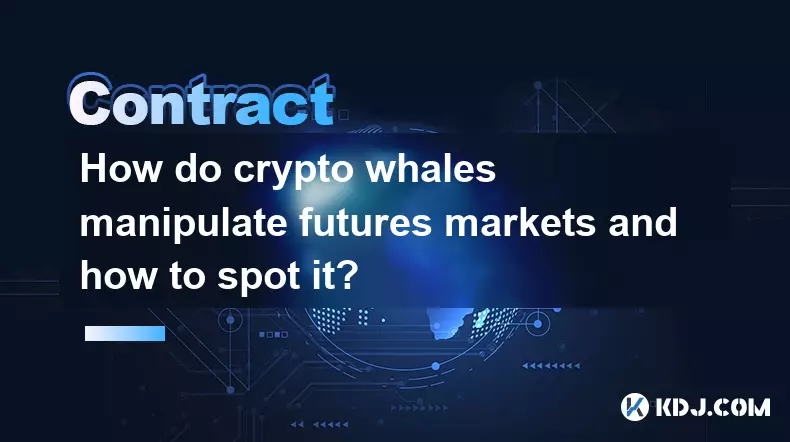
How do crypto whales manipulate futures markets and how to spot it?
Crypto whales manipulate futures markets via spoofing, iceberg orders, and stop-loss hunts, exploiting low liquidity and funding rate imbalances to trigger liquidations and profit from artificial volatility.
Nov 23, 2025 at 02:39 am
Crypto Whale Behavior in Futures Markets
1. Large traders, often referred to as 'whales,' exert significant influence on crypto futures markets through strategic positioning. By placing massive buy or sell orders, they can trigger cascading liquidations among leveraged traders. These sudden movements create artificial volatility, allowing whales to enter or exit positions at favorable prices.
2. Whales frequently use iceberg orders to hide the true size of their trades. Instead of placing one large order that would be visible on the order book, they split it into smaller chunks. This method prevents immediate market reaction while still achieving their desired market impact over time.
3. Another common tactic involves spoofing—placing large orders with no intention of execution. These phantom orders distort market sentiment and lure retail traders into false breakouts or breakdowns. Once smaller players react, whales quickly reverse their position and profit from the resulting price swing.
4. Funding rate manipulation is also observed. In perpetual futures contracts, funding rates are paid between long and short holders. Whales may accumulate extreme long or short positions to push funding rates into highly positive or negative territory, forcing weaker hands to close positions due to mounting costs.
5. Coordinated cross-exchange activity allows whales to amplify their influence. By initiating moves on lower-liquidity exchanges first, they induce slippage and momentum that then spills over to major platforms, enhancing the perception of broad market movement.
Indicators of Whale Market Manipulation
1. Sudden spikes in open interest without corresponding news or fundamental catalysts can signal whale accumulation. A rapid increase in the number of active contracts, especially during low-volume periods, suggests concentrated positioning by large actors.
2. Unusual order book imbalances are a red flag. If multiple large limit orders appear just below or above key price levels and vanish before being filled, this indicates potential spoofing. Persistent shadow walls in the order book often precede sharp price movements.
3. Price action that defies technical support and resistance zones without follow-through may point to manipulation. For example, a quick drop below a strong support level followed by an immediate reversal suggests a stop-loss hunt executed by whales.
4. Disproportionate liquidation clusters can reveal whale strategies. When large volumes of long or short positions get wiped out in seconds, particularly around round numbers or psychological price points, it's likely orchestrated by dominant market players.
5. Abnormal volume surges during off-peak trading hours, such as late UTC nights, often reflect whale activity. Retail participation is minimal during these times, making it easier for large traders to move prices with less resistance.
Tools and Strategies to Detect Whale Moves
1. On-chain analytics platforms like Glassnode or CryptoQuant provide insights into exchange inflows and outflows. A sudden transfer of thousands of BTC or ETH to a derivatives exchange often precedes aggressive futures positioning.
2. Order flow analysis tools track real-time trade executions and can highlight aggressive buying or selling pressure. Traders using depth charts and time & sales data can identify when large taker orders dominate the market.
3. Monitoring futures basis—the difference between futures and spot prices—helps detect excessive leverage buildup. Widening basis during bullish runs may indicate whale-driven long squeezes.
4. Social sentiment analysis combined with volume metrics can uncover coordinated pump-and-dump schemes. Platforms that aggregate Telegram, Discord, and Twitter chatter alongside trading data help correlate narrative shifts with whale behavior.
5. Custom alerts for large transactions or exchange wallet movements enable proactive responses before price reacts. Setting triggers for transfers above a certain threshold gives traders an early warning system.
Frequently Asked Questions
What is a stop-loss hunt in crypto futures?A stop-loss hunt occurs when large traders push the price to trigger clusters of stop-loss orders placed near known support or resistance levels. Once these orders execute, the price reverses, leaving retail traders trapped in losing positions while whales profit from the volatility.
How do funding rates expose whale influence?When funding rates become extremely positive or negative, it reflects an imbalance in long versus short positions. Whales can exploit this by maintaining oversized positions to prolong unfavorable funding conditions, forcing leveraged traders to exit at a loss.
Can retail traders compete with whales in futures markets?While retail traders cannot match whale capital, they can use transparency tools and disciplined risk management to avoid traps. Avoiding over-leverage and waiting for confirmed breakouts instead of chasing moves reduces vulnerability to manipulation.
What role does liquidity play in whale manipulation?Low-liquidity markets are more susceptible to price distortion. Whales target assets with shallow order books because smaller volumes are needed to generate significant price swings, amplifying their control over short-term market direction.
Disclaimer:info@kdj.com
The information provided is not trading advice. kdj.com does not assume any responsibility for any investments made based on the information provided in this article. Cryptocurrencies are highly volatile and it is highly recommended that you invest with caution after thorough research!
If you believe that the content used on this website infringes your copyright, please contact us immediately (info@kdj.com) and we will delete it promptly.






- UAE Investor Secures Major Stake in Trump-Linked Crypto Firm Amidst Shifting Geopolitical Tides
- 2026-02-02 07:10:01
- Pepe Meme Coin: Navigating the Hype, Price Predictions, and Future Outlook in 2026 and Beyond
- 2026-02-02 07:05:01
- Blockchain Gaming's Quiet Revolution: Unpacking Latest Trends and Industry Insights Amidst Market Shifts
- 2026-02-02 06:30:01
- IPO Genie, Tokenization, and YouTubers: The Big Apple's Next Big Bet on Democratized Wealth
- 2026-02-02 06:40:02
- Aptos in a Bind: Downtrend Deepens, But a Brief Relief Bounce Looms Before the Next Plunge
- 2026-02-02 07:00:01
- Pi Network, ATL, and Community: Navigating the Currents of a Mobile-First Crypto Movement
- 2026-02-02 07:00:01
Related knowledge
How to close a crypto contract position manually or automatically?
Feb 01,2026 at 11:19pm
Manual Position Closure Process1. Log into the trading platform where the contract is active and navigate to the 'Positions' or 'Open Orders' tab. 2. ...
How to understand the impact of Bitcoin ETFs on crypto contracts?
Feb 01,2026 at 04:19pm
Bitcoin ETFs and Market Liquidity1. Bitcoin ETFs introduce institutional capital directly into the spot market, increasing order book depth and reduci...
How to trade DeFi contracts during the current liquidity surge?
Feb 01,2026 at 07:00am
Understanding Liquidity Dynamics in DeFi Protocols1. Liquidity surges in DeFi are often triggered by coordinated capital inflows from yield farming in...
How to use social trading to copy crypto contract experts?
Feb 02,2026 at 07:40am
Understanding Social Trading Platforms1. Social trading platforms integrate real-time market data with user interaction features, enabling traders to ...
How to trade micro-cap crypto contracts with high growth potential?
Feb 01,2026 at 02:20pm
Understanding Micro-Cap Crypto Contracts1. Micro-cap crypto contracts refer to derivative instruments tied to tokens with market capitalizations under...
How to optimize your workspace for professional crypto contract trading?
Feb 01,2026 at 08:20pm
Hardware Infrastructure Requirements1. High-frequency crypto contract trading demands ultra-low latency execution. A dedicated workstation with a mini...
How to close a crypto contract position manually or automatically?
Feb 01,2026 at 11:19pm
Manual Position Closure Process1. Log into the trading platform where the contract is active and navigate to the 'Positions' or 'Open Orders' tab. 2. ...
How to understand the impact of Bitcoin ETFs on crypto contracts?
Feb 01,2026 at 04:19pm
Bitcoin ETFs and Market Liquidity1. Bitcoin ETFs introduce institutional capital directly into the spot market, increasing order book depth and reduci...
How to trade DeFi contracts during the current liquidity surge?
Feb 01,2026 at 07:00am
Understanding Liquidity Dynamics in DeFi Protocols1. Liquidity surges in DeFi are often triggered by coordinated capital inflows from yield farming in...
How to use social trading to copy crypto contract experts?
Feb 02,2026 at 07:40am
Understanding Social Trading Platforms1. Social trading platforms integrate real-time market data with user interaction features, enabling traders to ...
How to trade micro-cap crypto contracts with high growth potential?
Feb 01,2026 at 02:20pm
Understanding Micro-Cap Crypto Contracts1. Micro-cap crypto contracts refer to derivative instruments tied to tokens with market capitalizations under...
How to optimize your workspace for professional crypto contract trading?
Feb 01,2026 at 08:20pm
Hardware Infrastructure Requirements1. High-frequency crypto contract trading demands ultra-low latency execution. A dedicated workstation with a mini...
See all articles


