




















-
 bitcoin
 $87959.907984 USD
1.34% - ethereum
$2920.497338 USD
3.04% - tether
$0.999775 USD
0.00% - xrp
$2.237324 USD
8.12% - bnb
$860.243768 USD
0.90% - solana
$138.089498 USD
5.43% - usd-coin
$0.999807 USD
0.01% - tron
$0.272801 USD
-1.53% - dogecoin
$0.150904 USD
2.96% - cardano
$0.421635 USD
1.97% - hyperliquid
$32.152445 USD
2.23% - bitcoin-cash
$533.301069 USD
-1.94% - chainlink
$12.953417 USD
2.68% - unus-sed-leo
$9.535951 USD
0.73% - zcash
$521.483386 USD
-2.87%











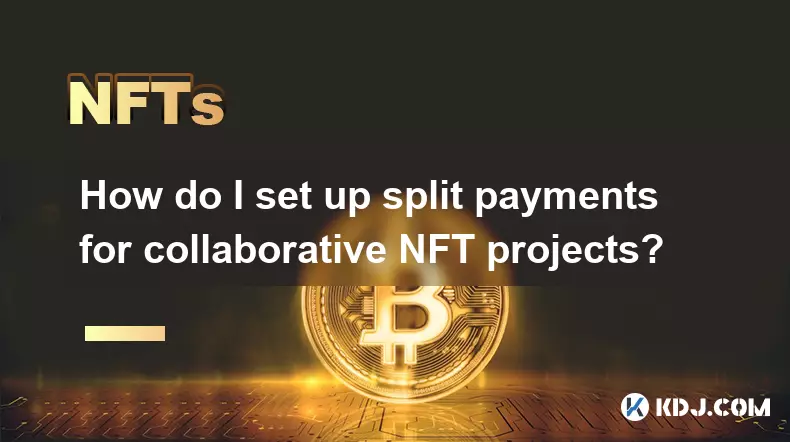
How do I set up split payments for collaborative NFT projects?
This NFT smart contract embeds immutable, ERC-2981–compliant revenue splits—verified off-chain, audited by CertiK, and routed via Gnosis Safe multisig—to ensure transparent, tax-ready royalty distribution across primary and secondary sales.
Jun 03, 2026 at 11:59 am
Smart Contract Configuration for Revenue Distribution
1. A split payment mechanism must be embedded directly into the NFT’s smart contract at deployment. This requires defining recipient addresses and fixed percentage allocations before minting begins.
2. The contract must support immutable or upgradable logic depending on project governance. Immutable contracts prevent post-deployment changes, while proxy-based upgradable patterns allow adjustments with multi-signature approval.
3. Ethereum-based implementations often use OpenZeppelin’s PaymentSplitter library, which enforces deterministic distribution across multiple payees and provides transparent on-chain withdrawal tracking.
4. For cross-chain music NFTs, developers integrate Chainlink Keepers to trigger payouts when secondary sales occur on platforms like Sound.xyz or Catalog, ensuring royalties flow regardless of marketplace.
5. Each collaborator’s wallet address must be verified off-chain prior to inclusion—unverified addresses risk permanent fund lockup or misdirection due to typographical errors.
On-Chain Royalty Enforcement Standards
1. ERC-2981 compliance is mandatory for automatic royalty enforcement across major marketplaces including Blur and LooksRare. Without it, platforms ignore custom payout rules during resale.
2. The royalty registry must list all contributors with precise weightings—e.g., 40% to producer, 35% to vocalist, 15% to visual artist, 10% to curator—and reflect those weights in both metadata and contract state.
3. Metadata stored on IPFS must include a royalty_recipients array matching the on-chain configuration; mismatched entries cause marketplace indexing failures.
4. Audits by firms like CertiK verify that fallback logic exists for edge cases such as zero-balance recipient wallets or failed ETH transfers, preventing silent failure during high-volume trading periods.
Multi-Signature Wallet Coordination
1. A Gnosis Safe multisig vault serves as the central treasury for primary sale proceeds before redistribution. Thresholds are set to require consensus—e.g., 3-of-5 signers—for any transfer out of the vault.
2. Signer roles are assigned based on contribution type: one signer represents the lead artist, another the technical developer, a third the community manager, and two reserved for independent auditors or legal representatives.
3. Transaction history remains fully public on Etherscan, enabling real-time verification by all stakeholders without requiring trust in intermediaries.
4. Scheduled payouts are automated via Safe{Wallet}’s transaction queue and executed only after confirmation from required signers, eliminating unilateral control over shared revenue.
Secondary Market Royalty Capture
1. Platforms like Zora enforce royalties only if the NFT’s tokenURI points to metadata containing valid royaltyBps and royaltyRecipient fields compliant with EIP-2981.
2. When an NFT trades on decentralized exchanges, event listeners monitor Transfer events and trigger corresponding royalty transfers using pre-approved allowances from the seller’s wallet.
3. Dynamic splits—where percentages change based on time elapsed or cumulative sales volume—are implemented via timestamped conditional logic within the contract, not through off-chain agreements.
4. Failure to register royalty parameters with Foundation or Manifold’s registry means marketplaces will default to zero-percent royalties, voiding all intended collaborative compensation.
Legal and Tax Documentation Alignment
1. Each contributor signs a digital agreement specifying their entitlement percentage, jurisdiction of enforcement, and dispute resolution venue—this document is hashed and stored on-chain as part of the NFT’s provenance record.
2. KYC-compliant wallets linked to verified identities are required for fiat off-ramps, especially when routing funds through services like Ramp Network or MoonPay for tax reporting purposes.
3. U.S.-based collaborators must receive IRS Form 1099-MISC if annual payouts exceed $600; automated tools like CoinTracker sync with Etherscan APIs to generate these reports directly from on-chain activity.
4. VAT treatment varies across EU member states—German collaborators report royalties as freelance income, while French recipients classify them under “droits d’auteur,” triggering different withholding obligations.
Frequently Asked Questions
Q: Can I change payout percentages after the NFT is minted?A: Only if the smart contract was deployed with upgradeable logic and all required signers approve the modification. Immutable contracts prohibit any alteration post-deployment.
Q: Do all marketplaces honor ERC-2981 royalty settings?A: No. OpenSea v2 and Blur support it natively. Rarible and LooksRare require manual activation. X2Y2 ignores it entirely unless enforced via custom wrapper contracts.
Q: What happens if a collaborator’s wallet is compromised?A: Funds destined for that address will be lost unless the contract includes a revocation or replacement function authorized by multisig governance.
Q: Is it possible to route royalties through a DAO treasury instead of individual wallets?A: Yes. Contracts can designate a DAO’s voting-governed multisig as the royalty recipient, allowing members to collectively decide fund allocation via on-chain proposals.
Disclaimer:info@kdj.com
The information provided is not trading advice. kdj.com does not assume any responsibility for any investments made based on the information provided in this article. Cryptocurrencies are highly volatile and it is highly recommended that you invest with caution after thorough research!
If you believe that the content used on this website infringes your copyright, please contact us immediately (info@kdj.com) and we will delete it promptly.






- Bitcoin, eCash Fork, and Airdrop Dynamics: A Deep Dive into Crypto's Latest Controversies
- 2026-05-03 12:55:01
- Consensus 2026 Miami: Web3, Blockchain, Cryptocurrency, NFTs, Metaverse, Conference, May 5th — Where Wall Street Meets the Digital Frontier
- 2026-05-02 12:45:01
- Fed Holds Rates Steady, Triggering Bitcoin Price Drop Amidst Geopolitical Tensions
- 2026-05-01 06:45:01
- Bitcoin Miners Electrify the Grid: Ohio Gas Plant Acquisition Powers Up a New Era for Digital Gold
- 2026-05-01 00:45:01
- MegaETH's MEGA Token Hits the Big Apple: Setting New Performance Benchmarks for Real-Time Blockchain
- 2026-05-01 00:55:01
- Solana's Slippery Slope: Price Prediction Points to Resistance Loss and Potential Further Drops
- 2026-05-01 06:45:01
Related knowledge

How do I list my NFT domain name for sale on Unstoppable Domains?
May 31,2026 at 04:40pm
Accessing the Unstoppable Domains Manager1. Navigate to the official Unstoppable Domains website and sign in using your registered email, Google, or X...

How do I create a subscription-based NFT with recurring access?
Jun 03,2026 at 03:40am
Understanding Subscription-Based NFTs1. A subscription-based NFT is a digital token that grants time-bound or conditional access to content, services,...

How do I track whale movements in the NFT market?
May 30,2026 at 02:20am
Understanding NFT Whale Identity1. An NFT whale is defined as an Ethereum wallet holding over $1 million worth of non-fungible tokens. 2. These wallet...

How do I use account abstraction to simplify NFT minting for users?
Jun 02,2026 at 08:39pm
Account Abstraction and User Experience Optimization1. Account abstraction enables wallet logic to be implemented entirely in smart contracts rather t...

How do I upgrade my NFT metadata after the initial reveal?
Jun 02,2026 at 11:59pm
On-Chain Metadata Modification Mechanisms1. The setTokenURI function in ERC-721 contracts enables administrators to update the URI pointing to off-cha...

How do I find undervalued NFT collections before they trend?
May 28,2026 at 05:20am
Bitcoin Halving Mechanics1. Bitcoin’s protocol enforces a fixed issuance schedule where block rewards are cut in half approximately every 210,000 bloc...
How do I list my NFT domain name for sale on Unstoppable Domains?
May 31,2026 at 04:40pm
Accessing the Unstoppable Domains Manager1. Navigate to the official Unstoppable Domains website and sign in using your registered email, Google, or X...
How do I create a subscription-based NFT with recurring access?
Jun 03,2026 at 03:40am
Understanding Subscription-Based NFTs1. A subscription-based NFT is a digital token that grants time-bound or conditional access to content, services,...
How do I track whale movements in the NFT market?
May 30,2026 at 02:20am
Understanding NFT Whale Identity1. An NFT whale is defined as an Ethereum wallet holding over $1 million worth of non-fungible tokens. 2. These wallet...
How do I use account abstraction to simplify NFT minting for users?
Jun 02,2026 at 08:39pm
Account Abstraction and User Experience Optimization1. Account abstraction enables wallet logic to be implemented entirely in smart contracts rather t...
How do I upgrade my NFT metadata after the initial reveal?
Jun 02,2026 at 11:59pm
On-Chain Metadata Modification Mechanisms1. The setTokenURI function in ERC-721 contracts enables administrators to update the URI pointing to off-cha...
How do I find undervalued NFT collections before they trend?
May 28,2026 at 05:20am
Bitcoin Halving Mechanics1. Bitcoin’s protocol enforces a fixed issuance schedule where block rewards are cut in half approximately every 210,000 bloc...
See all articles


