











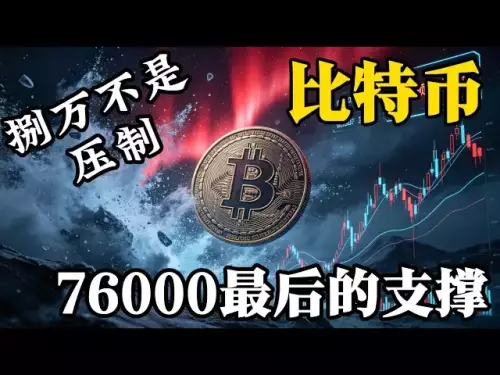


![There will be a violent washout of Bitcoin next. Don't buy the bottom too early. It won't stretch quickly in the short term. What you need to do now is to wait patiently for a good buying position, keep your bullets, and don't get hung up on it. When you buy the bottom, you will run out of bullets! Bitcoin market analysis [Issue 725]](/uploads/2026/08/23/cryptocurrencies-news/videos/origin_6a8afd33c749f_image_500_375.webp "There will be a violent washout of Bitcoin next. Don't buy the bottom too early. It won't stretch quickly in the short term. What you need to do now is to wait patiently for a good buying position, keep your bullets, and don't get hung up on it. When you buy the bottom, you will run out of bullets! Bitcoin market analysis [Issue 725]")






-
 bitcoin
 $76009.435780 USD
-1.53% - ethereum
$2375.311573 USD
-2.24% - tether
$0.999942 USD
0.01% - bnb
$682.047535 USD
-2.01% - xrp
$1.441787 USD
-5.55% - usd-coin
$1.000052 USD
0.00% - solana
$92.061879 USD
-1.80% - tron
$0.342038 USD
-0.93% - hyperliquid
$77.587999 USD
-1.41% - dogecoin
$0.089327 USD
-2.08% - zcash
$782.134934 USD
-0.71% - unus-sed-leo
$9.484522 USD
0.92% - chainlink
$11.132242 USD
-5.45% - monero
$431.110612 USD
0.39% - cardano
$0.214545 USD
-7.12%











How do I add utility to my NFT beyond digital art?
NFTs now serve as dynamic access keys—granting membership, governance rights, real-world asset ownership, DeFi utility, and evolving functionality via smart contracts and cross-chain interoperability.
May 28, 2026 at 02:39 pm
Access Control and Membership Privileges
1. An NFT can serve as a verifiable key granting entry to exclusive Discord servers, private Telegram groups, or gated content platforms hosted on Mirror or Lens Protocol.
2. Holders may receive early access to product launches, beta testing programs, or limited-edition physical merchandise tied to brand partnerships.
3. Some projects embed real-world utility by linking NFT ownership to co-ownership rights in tangible assets like vineyards, music royalties, or fractional real estate titles recorded on-chain.
4. Token-gated events—both virtual and in-person—leverage NFTs as dynamic tickets that auto-update with schedule changes, speaker additions, or venue shifts via smart contract triggers.
DeFi Integration and Financial Instrumentation
1. NFTs can represent collateralized debt positions within lending protocols such as Aave Arc or Compound’s isolated pools, where each token encodes loan terms, liquidation thresholds, and interest accrual logic.
2. Fractionalization through protocols like Fractional.art enables liquidity provision across ERC-20 shares backed by a single high-value NFT, allowing micro-investments and secondary market participation without full asset transfer.
3. Uniswap V3 concentrated liquidity positions are themselves represented as NFTs—each uniquely encoding price range, fee tier, and deposited asset amounts, making them tradable, composable, and composable across DeFi primitives.
4. Charged Particles allows users to attach yield-bearing tokens directly into the NFT metadata layer, transforming static collectibles into self-custodied, interest-generating vaults.
Real-World Asset Representation and Legal Anchoring
1. Tokenized invoices, warehouse receipts, or carbon credit certificates are minted as NFTs compliant with ERC-1400 or ERC-3643 standards, enabling regulatory-grade transfer restrictions and KYC/AML enforcement at the protocol level.
2. Physical goods authenticated via NFC chips or QR-linked serial numbers can be anchored to NFTs on Polygon ID or zkProofs, allowing tamper-proof provenance tracking from factory to end consumer.
3. Intellectual property rights—including licensing grants for commercial use, derivative creation, or merchandising—are encoded in on-chain licenses attached to NFTs using IP-NFT standards developed by Creative Commons and World Wide Web Consortium.
4. In jurisdictions like Singapore and Switzerland, NFTs backed by audited off-chain legal agreements have been recognized in court as enforceable instruments for debt settlement and equity distribution.
Governance Rights and Protocol Participation
1. NFTs function as non-transferable voting tokens in DAO governance frameworks, where weight is determined not by quantity but by rarity tier, staking duration, or historical contribution metrics embedded in metadata.
2. Certain ecosystem tokens require NFT ownership as a prerequisite for eligibility—such as receiving airdrops, participating in liquidity mining campaigns, or accessing protocol-specific fee discounts.
3. Curated contributor roles—like “Curator”, “Validator”, or “Ambassador”—are assigned via NFT issuance, with revocation or promotion governed by multisig committees or reputation-based consensus mechanisms.
4. On-chain identity layers like ENS subdomains or Galxe credentials are bound to NFTs, enabling persistent, portable reputation scores that influence voting power, delegation rights, and grant allocation across multiple dApps.
Dynamic Metadata and Evolving Functionality
1. Using Chainlink Automation or Gelato Network, NFT metadata can update in response to external data feeds—such as sports scores, weather conditions, or stock indices—triggering visual transformations or unlocking new features.
2. Time-locked utility activates automatically upon block height or timestamp milestones, revealing hidden content, granting temporary API keys, or enabling access to time-bound services like cloud storage or compute credits.
3. Cross-chain bridges powered by LayerZero or CCIP allow NFTs to retain functionality across ecosystems—e.g., an NFT minted on Arbitrum can trigger a reward claim on Base or initiate a mint on zkSync Era without manual redeployment.
4. On-chain game states stored in NFTs—like character levels, inventory items, or quest progress—enable true player-owned economies where progression persists across titles built on shared interoperability standards.
Frequently Asked Questions
Q: Can I legally enforce utility promises embedded in an NFT’s smart contract?Yes—if the NFT complies with jurisdiction-specific securities laws and includes enforceable off-chain legal wrappers, courts in Hong Kong, Germany, and the UAE have upheld contractual obligations tied to on-chain tokens.
Q: Do gas fees increase significantly when attaching utility functions to NFTs?No—Layer 2 solutions like Optimism and Base reduce utility-enabling transactions to under $0.02, and many protocols batch metadata updates or delegate computation to oracle networks to minimize on-chain cost.
Q: How do I prevent unauthorized replication of utility features across copycat NFT projects?By deploying utility logic inside audited, upgradeable contracts with immutable ownership controls, and registering trademarks or design patents for interface elements and interaction patterns tied to your NFT collection.
Q: Is it possible to revoke utility privileges from an NFT holder without burning the token?Yes—using revocable access control lists (ACLs) managed by DAO multisigs or decentralized identity attestations, utilities can be suspended or restored while preserving the NFT’s core provenance and collectibility.
Disclaimer:info@kdj.com
The information provided is not trading advice. kdj.com does not assume any responsibility for any investments made based on the information provided in this article. Cryptocurrencies are highly volatile and it is highly recommended that you invest with caution after thorough research!
If you believe that the content used on this website infringes your copyright, please contact us immediately (info@kdj.com) and we will delete it promptly.





- Bitcoin, eCash Fork, and Airdrop Dynamics: A Deep Dive into Crypto's Latest Controversies
- 2026-05-03 12:55:01
- Consensus 2026 Miami: Web3, Blockchain, Cryptocurrency, NFTs, Metaverse, Conference, May 5th — Where Wall Street Meets the Digital Frontier
- 2026-05-02 12:45:01
- Fed Holds Rates Steady, Triggering Bitcoin Price Drop Amidst Geopolitical Tensions
- 2026-05-01 06:45:01
- Bitcoin Miners Electrify the Grid: Ohio Gas Plant Acquisition Powers Up a New Era for Digital Gold
- 2026-05-01 00:45:01
- MegaETH's MEGA Token Hits the Big Apple: Setting New Performance Benchmarks for Real-Time Blockchain
- 2026-05-01 00:55:01
- Solana's Slippery Slope: Price Prediction Points to Resistance Loss and Potential Further Drops
- 2026-05-01 06:45:01
Related knowledge
What Is an NFT Utility? What Do You Actually Get Besides the Digital Asset?
Aug 21,2026 at 09:40am
Bitcoin Halving Mechanics1. Bitcoin’s protocol enforces a fixed issuance schedule where block rewards are cut in half approximately every 210,000 bloc...
What Is an NFT Drop? How Do You Find New NFT Collections Before They Sell Out?
Aug 23,2026 at 02:40am
Bitcoin Halving Mechanics1. Bitcoin’s protocol enforces a fixed issuance schedule where block rewards are cut in half approximately every 210,000 bloc...
What Is a Free NFT Mint? Is “Free” Really Free After Gas Fees?
Aug 22,2026 at 10:00am
Market Volatility Patterns1. Bitcoin price swings often exceed 5% within a 24-hour window during high-liquidity events such as ETF approval announceme...
What Is an NFT Trait? How Do Traits Determine an NFT’s Rarity?
Aug 20,2026 at 10:00am
Understanding NFT Traits1. An NFT trait is a distinct visual or functional attribute embedded within a token’s metadata, such as background color, clo...
What Is a Blue-Chip NFT? Which Collections Are Considered Blue Chips?
Aug 21,2026 at 02:40am
Definition and Core Characteristics1. Blue-chip NFTs refer to digital assets that demonstrate consistent market resilience, strong community engagemen...
What Is an NFT Burn? Why Would Someone Destroy a Valuable NFT?
Aug 22,2026 at 07:20pm
Understanding NFT Burning1. NFT burning is the irreversible removal of a non-fungible token from circulation by sending it to an inaccessible blockcha...
What Is an NFT Utility? What Do You Actually Get Besides the Digital Asset?
Aug 21,2026 at 09:40am
Bitcoin Halving Mechanics1. Bitcoin’s protocol enforces a fixed issuance schedule where block rewards are cut in half approximately every 210,000 bloc...
What Is an NFT Drop? How Do You Find New NFT Collections Before They Sell Out?
Aug 23,2026 at 02:40am
Bitcoin Halving Mechanics1. Bitcoin’s protocol enforces a fixed issuance schedule where block rewards are cut in half approximately every 210,000 bloc...
What Is a Free NFT Mint? Is “Free” Really Free After Gas Fees?
Aug 22,2026 at 10:00am
Market Volatility Patterns1. Bitcoin price swings often exceed 5% within a 24-hour window during high-liquidity events such as ETF approval announceme...
What Is an NFT Trait? How Do Traits Determine an NFT’s Rarity?
Aug 20,2026 at 10:00am
Understanding NFT Traits1. An NFT trait is a distinct visual or functional attribute embedded within a token’s metadata, such as background color, clo...
What Is a Blue-Chip NFT? Which Collections Are Considered Blue Chips?
Aug 21,2026 at 02:40am
Definition and Core Characteristics1. Blue-chip NFTs refer to digital assets that demonstrate consistent market resilience, strong community engagemen...
What Is an NFT Burn? Why Would Someone Destroy a Valuable NFT?
Aug 22,2026 at 07:20pm
Understanding NFT Burning1. NFT burning is the irreversible removal of a non-fungible token from circulation by sending it to an inaccessible blockcha...
See all articles


