





![[22. September 2026] BTC- und ALT-Preis-KI-Vorhersage / 8-Monats-Hoch von BTC, da Shorts im Wert von 750 Millionen US-Dollar liquidiert wurden (ENG SUB)](/uploads/2026/09/22/cryptocurrencies-news/videos/origin_6ab2232a324dc_image_500_375.webp "[22. September 2026] BTC- und ALT-Preis-KI-Vorhersage / 8-Monats-Hoch von BTC, da Shorts im Wert von 750 Millionen US-Dollar liquidiert wurden (ENG SUB)")






 |
|
 |
|
 |
|
 |
|
 |
|
 |
|
 |
|
 |
|
 |
|
 |
|
 |
|
 |
|
 |
|
 |
|
 |
|
Nachrichtenartikel zu Kryptowährungen
A Technical Decision Is Causing Waves in the Bitcoin Community
May 06, 2025 at 10:05 pm
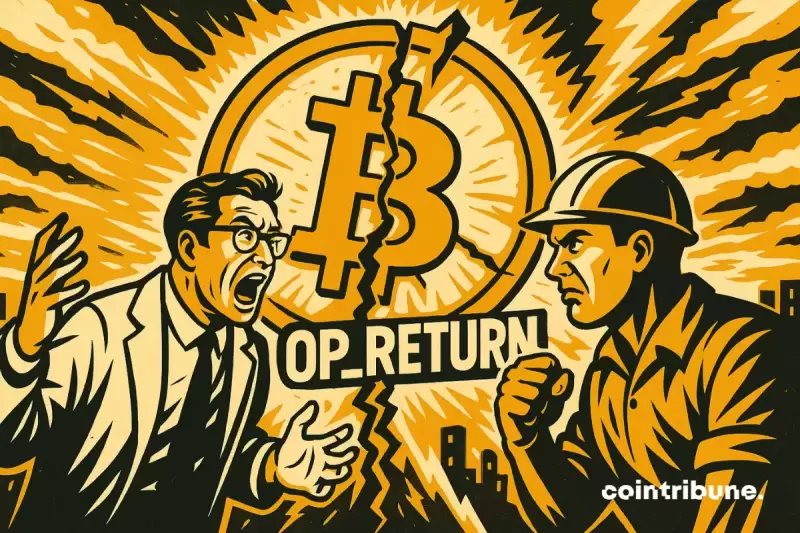
A technical decision by Bitcoin Core developers is stirring up the community, as it marks a change in the protocol’s core. For a long time, a limit of 80 bytes on the OP_RETURN field has prevented users from storing too much data in transactions, an action that was meant to remain light and discreet. However, today this symbolic barrier is seen as pointless and might even have had counterproductive effects.
This technical adjustment is heating up community discussions as it undermines the role of a few technical teams in making decisions that do not necessarily align with the collective interest.
A Rule That Has Become Counterproductive
OP_RETURN allows including data in a transaction without generating an UTXO. Introduced to avoid polluting scripts, it was a compromise: limited freedom for maximum security. The 80-byte limit aimed to deter large-scale content storage.
However, users quickly found ways to circumvent this rule. Some inserted their data via fake multisig scripts or used fake addresses, ultimately generating even more pollution.
Moreover, some miners disregarded this limit, rendering its application inconsistent.
As Greg Sanders, a Bitcoin Core developer, pointed out in the PR 32359 proposal on GitHub, "people are going to inscribe data regardless, and if they are limited to 80 bytes of OP_RETURN, they will use even worse and more opaque techniques to do so."
Thus, removing this limit appears to be a pragmatic choice, especially since the developers' philosophy is minimal interventionist:
"The fee market should decide what kinds of transactions get included in blocks and what uses of the Bitcoin protocol are valuable enough to pay for. We prefer to leave as much as possible to the market forces and not create new, technical limits on the protocol."
Of course, this does not mean that there will be no protection against abuse. But it will be targeted and adapted to real threats, in accordance with the project's direction: to avoid abuses while streamlining the protocol.
This change is therefore neither a revolution nor an abandonment of principles. It is a technical realignment with the network's actual practice.
Voices Rise Against the Change
This decision does not come without protest. For many users, this change was not discussed sufficiently and imposes technical choices without collective consent.
As Marty Bent, a prominent figure in the community, points out on X, "It’s clear that there is no consensus today on the OP_RETURN question."
On his side, Samson Mow calls for caution and invites those who disagree with this decision to remain on version 29.0 of Bitcoin Core or use another client like BitcoinKnots.
Indeed, the heart of the problem is this: who changes Bitcoin and how? Some denounce a gradual shift towards centralized governance, dominated by a few technical teams. The PR 32359 proposal, though discussed on GitHub, lacked community consultation.
This disagreement shows how fragile protocol governance remains. Users are not all ready to follow imposed changes, even when they seem logical.
What It Really Changes
Behind this technical quarrel, there are concrete implications for the network:
This change is a technical adjustment to the protocol, aiming to streamline it and leave more room for innovation. It also minimizes the intervention of Bitcoin Core developers in the types of transactions that miners select for inclusion in blocks.
The 80-byte limit on the OP_RETURN script was introduced in 2012 with the goal of preventing users from storing large amounts of data in transactions, an action that was meant to remain light and discreet. However, over time, this limit began to be seen as pointless and might even have had counterproductive effects.
As usage patterns evolved, the 80-byte limit began to be circumvented in various ways. For instance, some users began to insert their data via fake multisig scripts or used fake addresses, ultimately generating even more pollution.
Moreover, some miners ignored this limit, rendering its application inconsistent.
This technical decision might be minimal, but it is nonetheless part of a broader shift in the Bitcoin ecosystem.
Haftungsausschluss:info@kdj.com
Die bereitgestellten Informationen stellen keine Handelsberatung dar. kdj.com übernimmt keine Verantwortung für Investitionen, die auf der Grundlage der in diesem Artikel bereitgestellten Informationen getätigt werden. Kryptowährungen sind sehr volatil und es wird dringend empfohlen, nach gründlicher Recherche mit Vorsicht zu investieren!
Wenn Sie glauben, dass der auf dieser Website verwendete Inhalt Ihr Urheberrecht verletzt, kontaktieren Sie uns bitte umgehend (info@kdj.com) und wir werden ihn umgehend löschen.
-

- Near.com und Ondo Finance eröffnen neue Möglichkeiten für tokenisierte Aktien, ETFs und Rohstoffe
- Sep 23, 2026 at 04:05 am
- Near.com und Ondo Finance mischen die Investmentwelt auf, indem sie berechtigten Benutzern nahtlosen Zugriff auf tokenisierte Aktien, ETFs und Rohstoffe über ein einziges Konto gewähren und so die Integration traditioneller und digitaler Vermögenswerte rationalisieren.
-
- NEAR-Protokolllösungen bekämpfen verlorene Schlüssel und verbessern die Benutzerfreundlichkeit mit lesbaren Konten
- Sep 23, 2026 at 04:05 am
- Die neuen Funktionen des NEAR-Protokolls, darunter lesbare Kontonamen und eine robuste Schlüsselwiederherstellung, werden die Benutzererfahrung und Sicherheit der Blockchain revolutionieren und das Problem des anhaltenden Verlusts von Schlüsseln angehen.
-
- Zcash steht im Mittelpunkt: Europäische ETP-Einführung folgt auf US-ETF-Genehmigung und entfacht Debatte über „Bitcoin-Alternative“.
- Sep 23, 2026 at 04:05 am
- Zcash gewinnt mit neuen europäischen ETPs von 21Shares und einer vorherigen US-ETF-Zulassung an institutioneller Bedeutung, was trotz höherer Gebühren und behördlicher Kontrolle von Privacy Coins erneute Diskussionen über sein Potenzial als Bitcoin-Alternative auslöst.
-
- 21Shares erweitert Produktsuite mit neuem Zcash ETP und verbessert so den Zugang für europäische Anleger
- Sep 23, 2026 at 04:05 am
- 21Shares erweitert sein europäisches Krypto-ETP-Angebot durch die Einführung eines Zcash-ETP und markiert damit einen bedeutenden Schritt bei der Erweiterung regulierter Anlagemöglichkeiten für digitale Vermögenswerte.
-
- Aave-Kreditlimit, Bitcoin-gestützte Kredite: Strikes „volatilitätssichere“ Lösung inmitten der Verschärfung der Aave-Vorschläge
- Sep 23, 2026 at 04:05 am
- Strike führt ein „volatilitätssicheres“ Bitcoin-gestütztes Kreditprodukt ein, das Schutz vor marktbedingten Liquidationen bietet, da Aave erwägt, die Kreditlimits für BTC-gedeckte Positionen zu verschärfen, was möglicherweise die Liquidationsrisiken erhöht.
-
- CME Group erweitert Krypto-Angebote mit Bitcoin Cash und Uniswap-Futures angesichts des wachsenden institutionellen Interesses
- Sep 23, 2026 at 04:05 am
- Die CME Group führt Bitcoin Cash- und Uniswap-Futures ein und signalisiert damit einen bedeutenden Schritt bei der institutionellen Krypto-Einführung und dem Risikomanagement.
-
- White-Hat-Hacker sichern sich Bitcoin bei der Wiederherstellung von Coldcard-Exploits und entfachen damit eine Debatte über die Verwahrung von Geldern
- Sep 23, 2026 at 04:05 am
- White-Hat-Hacker greifen in einen Coldcard-Bitcoin-Exploit ein, transferieren Gelder an Recovery Trust und werfen Fragen zur Vermögensrückgewinnung und -verwahrung im Kryptoraum auf.
-
- Strives aufstrebendes Bitcoin-Finanzministerium: Ein New Yorker Geisteszustand für Unternehmenskrypto
- Sep 22, 2026 at 08:05 am
- Strive setzt seine starke Anhäufung von Bitcoin fort und präsentiert eine klare Strategie für das Treasury-Management von Unternehmen im digitalen Zeitalter. Dieser Schritt unterstreicht den wachsenden Trend bei Unternehmen, Krypto als Kernwert zu nutzen.
-
- Apple und Google nutzen Stablecoin-Experten und signalisieren damit einen großen Wandel in der Krypto-Zahlungsstrategie
- Sep 22, 2026 at 04:05 am
- Die Technologiegiganten Apple und Google stellen aktiv Stablecoin- und Blockchain-Spezialisten ein und signalisieren damit eine bedeutende Weiterentwicklung ihres Ansatzes für Kryptozahlungen und Finanzinfrastruktur.


