






 |
|
 |
|
 |
|
 |
|
 |
|
 |
|
 |
|
 |
|
 |
|
 |
|
 |
|
 |
|
 |
|
 |
|
 |
|
Nachrichtenartikel zu Kryptowährungen
Preisvorhersagen für Kryptowährungen mithilfe von maschinellem Lernen und der CoinGecko-API
Apr 09, 2024 at 06:06 pm
In this blog post, we delve into cryptocurrency price prediction using CoinGecko API and machine learning – the ability to learn patterns from data and make informed predictions.
In diesem Blogbeitrag befassen wir uns mit der Preisvorhersage für Kryptowährungen mithilfe der CoinGecko-API und maschinellem Lernen – der Fähigkeit, Muster aus Daten zu lernen und fundierte Vorhersagen zu treffen.
Level of Functionality
We'll first examine the key functionalities of our Python program:
FunktionsniveauWir werden zunächst die Schlüsselfunktionen unseres Python-Programms untersuchen:
- Fetching Data: The program fetches real-time and historical data from the CoinGecko API. This includes the current market data, historical data, and OHLC (Open, High, Low, Close) data for a specific coin.
- Data Processing: The program processes the fetched data to prepare it for the machine learning model. This includes selecting relevant features, scaling the data, and formatting it into the appropriate shape.
- Machine Learning Model: The program uses a Linear Regression model from the Scikit-learn library to learn from the processed data.
- Price Prediction: The program uses the trained model to predict future prices of the selected cryptocurrency.
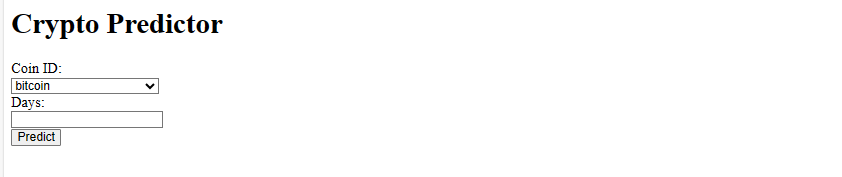
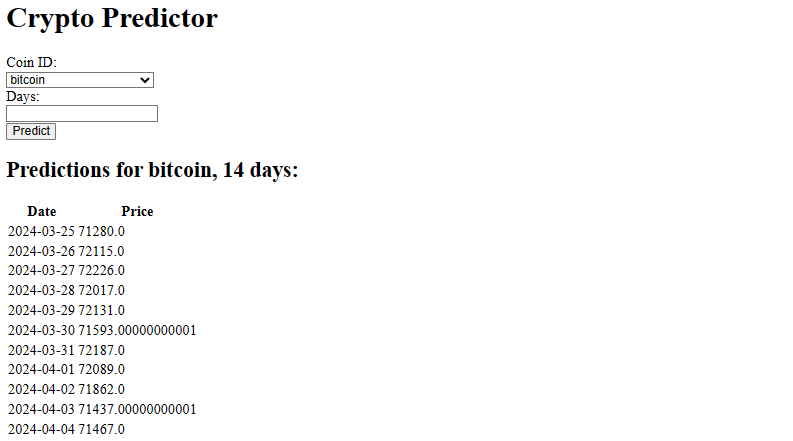
- Displaying Predictions: The program displays the predicted prices to the user in a simple and intuitive web interface. The user can select a coin and the number of days for which they want to predict prices, and the program will display the predictions in a table.
- User Interaction: The program provides an interactive form for the user to input their preferences. It also handles invalid inputs gracefully by displaying an error message.
- Security Measures: The program ensures the security of sensitive data such as API keys and private keys. It uses secure connections and encrypts sensitive data.
Which machine learning model is best for crypto price prediction?
Among the various machine learning models for crypto price prediction, the Linear Regression model is most optimal for predicting crypto prices because it is simple to understand and implement, and works well with linearly separable data. This model assumes a linear relationship between the input variables (independent variables) and a single output variable (dependent variable).
Daten abrufen: Das Programm ruft Echtzeit- und historische Daten von der CoinGecko-API ab. Dazu gehören die aktuellen Marktdaten, historischen Daten und OHLC-Daten (Open, High, Low, Close) für eine bestimmte Münze. Datenverarbeitung: Das Programm verarbeitet die abgerufenen Daten, um sie für das maschinelle Lernmodell vorzubereiten. Dazu gehört die Auswahl relevanter Funktionen, die Skalierung der Daten und deren Formatierung in die entsprechende Form. Modell für maschinelles Lernen: Das Programm verwendet ein lineares Regressionsmodell aus der Scikit-learn-Bibliothek, um aus den verarbeiteten Daten zu lernen. Preisvorhersage: Das Programm verwendet die trainierten Modell, um zukünftige Preise der ausgewählten Kryptowährung vorherzusagen. Vorhersagen anzeigen: Das Programm zeigt dem Benutzer die vorhergesagten Preise in einer einfachen und intuitiven Weboberfläche an. Der Benutzer kann eine Münze und die Anzahl der Tage auswählen, für die er Preise vorhersagen möchte, und das Programm zeigt die Vorhersagen in einer Tabelle an. Benutzerinteraktion: Das Programm stellt dem Benutzer ein interaktives Formular zur Eingabe seiner Präferenzen zur Verfügung. Außerdem werden ungültige Eingaben ordnungsgemäß behandelt, indem eine Fehlermeldung angezeigt wird. Sicherheitsmaßnahmen: Das Programm gewährleistet die Sicherheit sensibler Daten wie API-Schlüssel und private Schlüssel. Es verwendet sichere Verbindungen und verschlüsselt vertrauliche Daten.Welches Modell des maschinellen Lernens eignet sich am besten für die Vorhersage von Kryptopreisen? Unter den verschiedenen Modellen des maschinellen Lernens für die Vorhersage von Kryptopreisen eignet sich das lineare Regressionsmodell am besten für die Vorhersage von Kryptopreisen, da es einfach zu verstehen und zu implementieren ist und funktioniert gut mit linear trennbaren Daten. Dieses Modell geht von einer linearen Beziehung zwischen den Eingangsvariablen (unabhängigen Variablen) und einer einzelnen Ausgangsvariablen (abhängigen Variablen) aus.
When this assumption holds true, Linear Regression can provide a good baseline model for crypto price prediction. However, it’s important to note that crypto prices are influenced by a multitude of factors and may not always exhibit a linear relationship. Therefore, more complex models may sometimes offer better predictive performance. Always remember to validate the assumptions of your model and test its performance using appropriate metrics.
Wenn diese Annahme zutrifft, kann die lineare Regression ein gutes Basismodell für die Kryptopreisvorhersage liefern. Es ist jedoch wichtig zu beachten, dass die Kryptopreise von einer Vielzahl von Faktoren beeinflusst werden und möglicherweise nicht immer eine lineare Beziehung aufweisen. Daher können komplexere Modelle manchmal eine bessere Vorhersageleistung bieten. Denken Sie immer daran, die Annahmen Ihres Modells zu validieren und seine Leistung anhand geeigneter Metriken zu testen.
Prerequisites
Before we start, ensure you have the following:
VoraussetzungenBevor wir beginnen, stellen Sie sicher, dass Sie über Folgendes verfügen:
- Python 3.7 or higher installed on your system. Python is a powerful, easy-to-learn programming language that we will use to build our bot.
- A basic understanding of Python programming. While this guide will be detailed, having a basic understanding of Python syntax and programming concepts will be beneficial.
- A text editor: You will need a text editor or an Integrated Development Environment (IDE) to write your code. Some popular options include Visual Studio Code, Sublime Text, and Atom.
- CoinGecko API (Demo): We will be using CoinGecko API to fetch the market chart data for cryptocurrencies. The CoinGecko API has a free Demo plan accessible to all users with a 30 calls/min rate limit and a monthly cap of 10,000 calls. This guide shows you how to generate your Demo API key.
Do note that the API key used in this guide is a placeholder and not a real API key. Please replace it with your own CoinGecko API key for the code to work.
Python 3.7 oder höher ist auf Ihrem System installiert. Python ist eine leistungsstarke, leicht zu erlernende Programmiersprache, die wir zum Erstellen unseres Bots verwenden werden. Ein grundlegendes Verständnis der Python-Programmierung. Obwohl dieser Leitfaden ausführlich ist, ist es von Vorteil, über ein grundlegendes Verständnis der Python-Syntax und der Programmierkonzepte zu verfügen. Ein Texteditor: Sie benötigen einen Texteditor oder eine integrierte Entwicklungsumgebung (Integrated Development Environment, IDE), um Ihren Code zu schreiben. Zu den beliebten Optionen gehören Visual Studio Code, Sublime Text und die Atom.CoinGecko-API (Demo): Wir werden die CoinGecko-API verwenden, um die Marktdiagrammdaten für Kryptowährungen abzurufen. Die CoinGecko-API verfügt über einen kostenlosen Demo-Plan, der allen Benutzern zugänglich ist, mit einem Tariflimit von 30 Anrufen/Minute und einer monatlichen Obergrenze von 10.000 Anrufen. In dieser Anleitung erfahren Sie, wie Sie Ihren Demo-API-Schlüssel generieren. Beachten Sie, dass der in dieser Anleitung verwendete API-Schlüssel ein Platzhalter und kein echter API-Schlüssel ist. Bitte ersetzen Sie ihn durch Ihren eigenen CoinGecko-API-Schlüssel, damit der Code funktioniert.
The Python Program
The program is a Flask web application. It starts by importing necessary libraries and initializing a Flask app:
Das Python-ProgrammDas Programm ist eine Flask-Webanwendung. Zunächst werden die erforderlichen Bibliotheken importiert und eine Flask-App initialisiert:
In this section, we’ll break down the Python code for our Cryptocurrency prediction to understand each part and its role in the overall functionality of the predictor:
In diesem Abschnitt werden wir den Python-Code für unsere Kryptowährungsvorhersage aufschlüsseln, um jeden Teil und seine Rolle in der Gesamtfunktionalität des Prädiktors zu verstehen:
Importing Necessary Libraries and Modules: The program commences by importing the necessary libraries and modules. These include Flask, a micro web framework written in Python that provides tools, technologies, and possibilities for web application development. It also imports requests, a Python module used for making various types of HTTP requests like GET and POST.
Erforderliche Bibliotheken und Module importieren: Das Programm beginnt mit dem Import der erforderlichen Bibliotheken und Module. Dazu gehört Flask, ein in Python geschriebenes Micro-Web-Framework, das Tools, Technologien und Möglichkeiten für die Entwicklung von Webanwendungen bereitstellt. Es importiert auch Anfragen, ein Python-Modul, das zum Erstellen verschiedener Arten von HTTP-Anfragen wie GET und POST verwendet wird.
Setting Up Flask Application and API Key: The Flask application is set up, creating an instance of the Flask class which is our WSGI application. The API key for accessing the CoinGecko API, a comprehensive cryptocurrency API that provides access to a wide range of data, is defined.
Einrichten der Flask-Anwendung und des API-Schlüssels: Die Flask-Anwendung wird eingerichtet und eine Instanz der Flask-Klasse erstellt, die unsere WSGI-Anwendung ist. Der API-Schlüssel für den Zugriff auf die CoinGecko-API, eine umfassende Kryptowährungs-API, die Zugriff auf eine Vielzahl von Daten bietet, ist definiert.
Defining the Main Route: The main route (/) is defined, which supports both GET and POST methods. When a GET request is made, it fetches the list of available coins from the CoinGecko API. This is done by making a GET request to the CoinGecko API endpoint, which returns a list of all available cryptocurrencies.
Definieren der Hauptroute: Die Hauptroute (/) wird definiert, die sowohl GET- als auch POST-Methoden unterstützt. Wenn eine GET-Anfrage gestellt wird, ruft sie die Liste der verfügbaren Münzen von der CoinGecko-API ab. Dies erfolgt durch eine GET-Anfrage an den CoinGecko-API-Endpunkt, der eine Liste aller verfügbaren Kryptowährungen zurückgibt.
Handling POST Requests: If a POST request is made, it gets the coin_id and days from the form data. If the coin_id is valid, it calls the get_market_chart function with coin_id and days as parameters. This function fetches the market chart data for the given coin over the specified number of days.
Umgang mit POST-Anfragen: Wenn eine POST-Anfrage gestellt wird, werden die Münz-ID und die Tage aus den Formulardaten abgerufen. Wenn die „coin_id“ gültig ist, wird die Funktion „get_market_chart“ mit „coin_id“ und „days“ als Parameter aufgerufen. Diese Funktion ruft die Marktdiagrammdaten für die angegebene Münze über die angegebene Anzahl von Tagen ab.
Defining the get_market_chart Function: This function does several things, namely, it calculates the start and end timestamps based on the number of days, fetches the OHLC (Open, High, Low, Close) data for the given coin_id and days, and fetches the historical data for a specific date and the current market data from the CoinGecko API. Next, it prepares the feature matrix X and target vector y for the linear regression model, and scales the data using MinMaxScaler, a feature scaling technique that transforms features by scaling each feature to a given range. Thereafter, it trains the LinearRegression model with X and y and makes predictions using the trained model. It creates a list of dates for the predictions and combines the dates and predictions into a dictionary, and finally, it returns the predictions.
Definieren der Funktion get_market_chart: Diese Funktion führt mehrere Aufgaben aus, nämlich die Berechnung der Start- und Endzeitstempel basierend auf der Anzahl der Tage, ruft die OHLC-Daten (Open, High, Low, Close) für die angegebene Coin_ID und die angegebenen Tage ab und ruft die ab historische Daten für ein bestimmtes Datum und die aktuellen Marktdaten aus der CoinGecko-API. Als Nächstes bereitet es die Merkmalsmatrix Anschließend trainiert es das LinearRegression-Modell mit X und Y und trifft anhand des trainierten Modells Vorhersagen. Es erstellt eine Liste mit Daten für die Vorhersagen, kombiniert die Daten und Vorhersagen in einem Wörterbuch und gibt schließlich die Vorhersagen zurück.
Running the Flask Application: Finally, if the script is run directly, it starts the Flask development server. This server is a built-in, lightweight WSGI web server and provides a quick way to run the application. It is however not recommended for production environments.
Ausführen der Flask-Anwendung: Wenn das Skript schließlich direkt ausgeführt wird, startet es den Flask-Entwicklungsserver. Dieser Server ist ein integrierter, leichter WSGI-Webserver und bietet eine schnelle Möglichkeit, die Anwendung auszuführen. Es wird jedoch nicht für Produktionsumgebungen empfohlen.
HTML Structure of the Crypto Price Predictons
This application allows users to select a cryptocurrency and a number of days, and then predicts the price of the selected cryptocurrency for the specified number of days. The predictions are displayed in a table format.
HTML-Struktur der Krypto-Preisvorhersagen: Mit dieser Anwendung können Benutzer eine Kryptowährung und eine Anzahl von Tagen auswählen und dann den Preis der ausgewählten Kryptowährung für die angegebene Anzahl von Tagen vorhersagen. Die Vorhersagen werden in einem Tabellenformat angezeigt.
If there’s an error, such as an invalid coin ID, the application displays an error message. The application uses Jinja templating for dynamic content rendering, which allows it to display different content based on the user’s input and the results of the price prediction.
Wenn ein Fehler vorliegt, beispielsweise eine ungültige Münz-ID, zeigt die Anwendung eine Fehlermeldung an. Die Anwendung nutzt Jinja-Templating für die dynamische Inhaltswiedergabe, was es ihr ermöglicht, unterschiedliche Inhalte basierend auf den Eingaben des Benutzers und den Ergebnissen der Preisvorhersage anzuzeigen.
Installing Required Python Libraries
Before running the Python program, it’s important to ensure that all the necessary Python libraries are installed. Here’s a brief explanation of the libraries used in the program and how to install them:
Erforderliche Python-Bibliotheken installieren Bevor Sie das Python-Programm ausführen, müssen Sie sicherstellen, dass alle erforderlichen Python-Bibliotheken installiert sind. Hier finden Sie eine kurze Erklärung der im Programm verwendeten Bibliotheken und deren Installation:
- Flask: Flask is a lightweight web application framework. It’s used to create the web interface for the program. Install it with pip:
pip install flask - requests: Requests is a library for making HTTP requests. It’s used to fetch data from the CoinGecko API. Install it with pip:
pip install requests - json: The json module is used to parse the JSON data returned by the CoinGecko API. It’s included in the standard Python library, so you don’t need to install it separately.
- NumPy: NumPy is a library for numerical computing. It’s used to manipulate the data fetched from the API. Install it with pip:
pip install numpy - scikit-learn: Scikit-learn is a library for machine learning. It’s used to create the linear regression model for price prediction. Install it with pip:
pip install scikit-learn - time: The time module is used to work with timestamps. It’s included in the standard Python library, so you don’t need to install it separately.
- datetime: The datetime module is used to work with dates and times. It’s included in the standard Python library, so you don’t need to install it separately.
To install all these libraries at once, you can use the following command:
Flask: Flask ist ein leichtes Webanwendungs-Framework. Es wird verwendet, um die Weboberfläche für das Programm zu erstellen. Installieren Sie es mit pip: pip install flaskrequests: Requests ist eine Bibliothek zum Senden von HTTP-Anfragen. Es wird verwendet, um Daten von der CoinGecko-API abzurufen. Installieren Sie es mit pip: pip install requestjson: Das JSON-Modul wird zum Parsen der von der CoinGecko-API zurückgegebenen JSON-Daten verwendet. Es ist in der Standard-Python-Bibliothek enthalten, sodass Sie es nicht separat installieren müssen.NumPy: NumPy ist eine Bibliothek für numerische Berechnungen. Es wird verwendet, um die von der API abgerufenen Daten zu manipulieren. Installieren Sie es mit pip: pip install numpyscikit-learn: Scikit-learn ist eine Bibliothek für maschinelles Lernen. Es wird verwendet, um das lineare Regressionsmodell für die Preisvorhersage zu erstellen. Installieren Sie es mit pip: pip install scikit-learntime: Das Zeitmodul wird verwendet, um mit Zeitstempeln zu arbeiten. Es ist in der Standard-Python-Bibliothek enthalten, sodass Sie es nicht separat installieren müssen. datetime: Das datetime-Modul wird zum Arbeiten mit Datums- und Uhrzeitangaben verwendet. Es ist in der Standard-Python-Bibliothek enthalten, sodass Sie es nicht separat installieren müssen. Um alle diese Bibliotheken auf einmal zu installieren, können Sie den folgenden Befehl verwenden:
pip install flask requests numpy scikit-learn
pip install flask fordert Numpy Scikit-Learn an
Remember to run these commands in your virtual environment if you’re using one. This will keep your global Python environment clean and manage dependencies for this project separately. If you’re not using a virtual environment, you might need to use pip3 instead of pip and add sudo at the beginning of the commands to install the libraries globally.
Denken Sie daran, diese Befehle in Ihrer virtuellen Umgebung auszuführen, falls Sie eine verwenden. Dadurch bleibt Ihre globale Python-Umgebung sauber und die Abhängigkeiten für dieses Projekt werden separat verwaltet. Wenn Sie keine virtuelle Umgebung verwenden, müssen Sie möglicherweise pip3 anstelle von pip verwenden und sudo am Anfang der Befehle hinzufügen, um die Bibliotheken global zu installieren.
Testing the Cryptocurrency Prediction
To test the predictor, follow these steps:
Testen der KryptowährungsvorhersageUm den Prädiktor zu testen, gehen Sie folgendermaßen vor:
Run the Python script in your terminal using python
.py, in this case python predictor.py Führen Sie das Python-Skript in Ihrem Terminal mit Python .py aus, in diesem Fall Python Predictor.py
Open the Web Application: Once the Flask server is running, open a web browser and navigate to the local server’s address (usually http://localhost:5000).
Öffnen Sie die Webanwendung: Sobald der Flask-Server ausgeführt wird, öffnen Sie einen Webbrowser und navigieren Sie zur Adresse des lokalen Servers (normalerweise http://localhost:5000).
Select a Cryptocurrency: You’ll see a form with a dropdown list of cryptocurrencies. Select the cryptocurrency you’re interested in.
Wählen Sie eine Kryptowährung aus: Sie sehen ein Formular mit einer Dropdown-Liste der Kryptowährungen. Wählen Sie die Kryptowährung aus, an der Sie interessiert sind.
Enter the Number of Days: In the ‘Days’ input field, enter the number of days for which you want to predict prices.
Geben Sie die Anzahl der Tage ein: Geben Sie im Eingabefeld „Tage“ die Anzahl der Tage ein, für die Sie Preise vorhersagen möchten.
Submit the Form: Click the ‘Predict’ button to submit the form. The program will now fetch the relevant data, train the machine learning model, and make predictions.
Senden Sie das Formular: Klicken Sie auf die Schaltfläche „Vorhersagen“, um das Formular abzusenden. Das Programm ruft nun die relevanten Daten ab, trainiert das maschinelle Lernmodell und trifft Vorhersagen.
View the Predictions: The predicted prices will be displayed in a table on the webpage. Each row in the table represents one day, with the date and the predicted price.
Vorhersagen anzeigen: Die vorhergesagten Preise werden in einer Tabelle auf der Webseite angezeigt. Jede Zeile in der Tabelle stellt einen Tag dar, mit Datum und vorhergesagtem Preis.
Test Different Cryptocurrencies and Timeframes: Try selecting different cryptocurrencies and entering different numbers of days. Check whether the program returns reasonable predictions and handles edge cases well (e.g., a very large number of days).
Testen Sie verschiedene Kryptowährungen und Zeitrahmen: Versuchen Sie, verschiedene Kryptowährungen auszuwählen und unterschiedliche Anzahlen von Tagen einzugeben. Überprüfen Sie, ob das Programm vernünftige Vorhersagen liefert und Randfälle gut verarbeitet (z. B. eine sehr große Anzahl von Tagen).

Remember, the accuracy of the predictions depends on many factors, including the volatility of the cryptocurrency market and the amount of historical data available. Always use such predictions as just one of many tools in your cryptocurrency trading toolkit.
Bedenken Sie, dass die Genauigkeit der Vorhersagen von vielen Faktoren abhängt, einschließlich der Volatilität des Kryptowährungsmarktes und der Menge der verfügbaren historischen Daten. Verwenden Sie solche Vorhersagen immer nur als eines von vielen Tools in Ihrem Kryptowährungs-Trading-Toolkit.
Advanced Functionalities and Useful Endpoints
While the guide above covers the basic development of a cryptocurrency price prediction program, CoinGecko API offers a wealth of endpoints that can be used to add more advanced functionalities. Here are some possibilities:
- Historical Snapshots: The ‘/coins/{id}/history’ endpoint provides historical data for a specific date. This could be used to add a feature that allows users to view ‘snapshots’ of the market at different points in the past.
- Anomaly Detection: By using the ‘/coins/markets’ endpoint to fetch real-time market data, you could implement an anomaly detection feature, which alerts users to sudden significant changes in a coin’s price or trading volume.
- Coin Information: The ‘/coins/{id}’ endpoint returns detailed information about a specific coin, from tickers, market data, community data, metadata and more. This could provide users with information on development status, community strength, public interest and more.
- Trending Coins: The ‘/search/trending’ endpoint provides information about trending coins in the last 24 hours. This data point can keep users informed about which coins are currently popular in the market.

Conclusion
In conclusion, this Python program demonstrates the power of machine learning and APIs in predicting cryptocurrency prices. By leveraging the CoinGecko API, the program fetches real-time and historical market data, which is then used to train a linear regression model for Bitcoin price predictions. The program also provides an intuitive web interface for users to interact with, making it a practical tool for anyone interested in cryptocurrencies.
Moreover, the CoinGecko API offers a wealth of endpoints that can be used to add more advanced functionalities to the program, such as sentiment analysis, anomaly detection, historical snapshots, coin information, and trending coins. These functionalities can provide users with deeper insights and a more comprehensive understanding of the cryptocurrency market.
Darüber hinaus bietet die CoinGecko-API eine Fülle von Endpunkten, die verwendet werden können, um dem Programm erweiterte Funktionen hinzuzufügen, wie z. B. Stimmungsanalyse, Anomalieerkennung, historische Schnappschüsse, Münzinformationen und Trendmünzen. Diese Funktionalitäten können Benutzern tiefere Einblicke und ein umfassenderes Verständnis des Kryptowährungsmarktes bieten.
Testing the program is a crucial step to ensure its accuracy and reliability. By following the step-by-step guide provided, users can test different cryptocurrencies and timeframes, and check the program’s performance under various scenarios.
Das Testen des Programms ist ein entscheidender Schritt, um seine Genauigkeit und Zuverlässigkeit sicherzustellen. Durch Befolgen der bereitgestellten Schritt-für-Schritt-Anleitung können Benutzer verschiedene Kryptowährungen und Zeitrahmen testen und die Leistung des Programms in verschiedenen Szenarien überprüfen.
Remember, while such a program can provide valuable predictions and insights, it should be used as just one of many tools in your cryptocurrency trading toolkit. Always consider multiple factors, sources of information and do your own research when making trading decisions. Happy coding and trading!
Denken Sie daran, dass ein solches Programm zwar wertvolle Vorhersagen und Erkenntnisse liefern kann, es jedoch nur als eines von vielen Tools in Ihrem Kryptowährungs-Trading-Toolkit verwendet werden sollte. Berücksichtigen Sie bei Handelsentscheidungen immer mehrere Faktoren und Informationsquellen und recherchieren Sie selbst. Viel Spaß beim Codieren und Handeln!
If you found this tutorial useful, check out other similar API Guides.
Wenn Sie dieses Tutorial nützlich fanden, schauen Sie sich andere ähnliche API-Anleitungen an.


Rollend is a Microsoft Certified Cloud Architect with 16 years of experience. He is the author of the book “Automate Your Life: Streamline Your Daily Tasks with Python: 30 Powerful Ways to Streamline Your Daily Tasks with Python”.Follow the author on Twitter @RollendXavier
Redaktionelle Richtlinien für den Inhalt von CoinGecko Der Inhalt von CoinGecko zielt darauf ab, die Kryptoindustrie zu entmystifizieren. Auch wenn bestimmte Beiträge, die Sie sehen, möglicherweise gesponsert sind, bemühen wir uns, die höchsten Standards an redaktioneller Qualität und Integrität einzuhalten und veröffentlichen keine Inhalte, die nicht von unseren Redakteuren überprüft wurden. Erfahren Sie mehr Sagen Sie uns, wie sehr Ihnen dieser Artikel gefällt! Rollend XavierRollend ist ein Microsoft Certified Cloud Architect mit 16 Jahren Erfahrung. Er ist der Autor des Buches „Automatisieren Sie Ihr Leben: Optimieren Sie Ihre täglichen Aufgaben mit Python: 30 leistungsstarke Möglichkeiten, Ihre täglichen Aufgaben mit Python zu optimieren“. Folgen Sie dem Autor auf Twitter @RollendXavier
Lesen Sie mehr von Rollend Xavier
Haftungsausschluss:info@kdj.com
Die bereitgestellten Informationen stellen keine Handelsberatung dar. kdj.com übernimmt keine Verantwortung für Investitionen, die auf der Grundlage der in diesem Artikel bereitgestellten Informationen getätigt werden. Kryptowährungen sind sehr volatil und es wird dringend empfohlen, nach gründlicher Recherche mit Vorsicht zu investieren!
Wenn Sie glauben, dass der auf dieser Website verwendete Inhalt Ihr Urheberrecht verletzt, kontaktieren Sie uns bitte umgehend (info@kdj.com) und wir werden ihn umgehend löschen.
-

-
- Konsens 2026 Miami: Web3, Blockchain, Kryptowährung, NFTs, Metaverse, Konferenz, 5. Mai – Wo die Wall Street auf die digitale Grenze trifft
- May 01, 2026 at 11:27 pm
- In Miami herrscht Aufregung, während sich am 5. Mai der Konsens 2026 nähert, der Web3, Blockchain, Krypto, NFTs und den Wandel des Metaversums vom Hype zur institutionellen und nachhaltigen Realität hervorhebt.
-
- Die Fed hält die Zinsen stabil, was inmitten geopolitischer Spannungen einen Bitcoin-Preisverfall auslöst
- May 01, 2026 at 04:04 am
- Die Entscheidung der Federal Reserve, die Zinssätze beizubehalten, wirkt sich in Verbindung mit dem Nahostkonflikt auf den Preis von Bitcoin aus. Analyse aktueller Trends und Marktreaktionen.
-
- Bitcoin-Miner elektrifizieren das Netz: Der Erwerb eines Gaskraftwerks in Ohio läutet eine neue Ära für digitales Gold ein
- Apr 30, 2026 at 10:38 pm
- Die Bitcoin-Mining-Branche befindet sich in einem erheblichen Wandel, wobei große Akteure ihre Aktivitäten aggressiv ausweiten und strategisch Energieanlagen wie Gaskraftwerke in Ohio erwerben, um ihre Zukunft in der digitalen Wirtschaft zu festigen.
-
- Der MEGA-Token von MegaETH erreicht den Big Apple: Er setzt neue Leistungsmaßstäbe für Echtzeit-Blockchain
- Apr 30, 2026 at 09:11 pm
- Der MEGA-Token von MegaETH wurde offiziell eingeführt und bestätigt seine „Echtzeit“-Blockchain-Vision mit einem leistungsorientierten Verteilungsmodell und einer schnellen USDM-Stablecoin-Einführung.
-
- Solanas rutschiger Abhang: Die Preisprognose deutet auf einen Widerstandsverlust und mögliche weitere Rückgänge hin
- Apr 30, 2026 at 09:08 pm
- Solana kämpft darum, wichtige Widerstände zu durchbrechen, was auf einen möglichen Abwärtstrend hindeutet. Wiederholte Ablehnungen bei 86 bis 88 US-Dollar, gepaart mit einem unterbrochenen kurzfristigen Muster, deuten auf Ziele von nur 67 US-Dollar oder sogar 40 US-Dollar hin, da die Verkäufer die Kontrolle behalten. Anleger sollten die kritischen Unterstützungsniveaus genau beobachten.
-
- BTC, Öl, Gewinne: Geopolitik treibt Rohöl an, Kryptos rutschen ab, Triumphe und Prüfungen der Technologie
- Apr 30, 2026 at 04:51 pm
- Die globalen Märkte sind ein Wirbelsturm: BTC sinkt, während der Ölpreis aufgrund geopolitischer Spannungen Mehrjahreshöchststände erreicht, während Technologiegiganten gemischte Gewinne verbuchen, was ein Zeichen für eine komplexe Finanzlandschaft ist.
-
- New York Citys neuer Trend: Abstecksysteme, USD1 und Governance treiben die nächste Welle von Krypto voran
- Apr 30, 2026 at 03:02 pm
- Von lukrativen 1-Dollar-Verdienstveranstaltungen bis hin zu robusten Governance-Modellen wimmelt es im Kryptobereich von Innovationen, die die Art und Weise, wie wir mit digitalen Vermögenswerten umgehen, neu gestalten und sich dabei auf langfristiges Engagement und den Nutzen stabiler Münzen konzentrieren.
-
- OKX stellt Agent Payments Protocol vor: läutet eine neue Ära der KI-Transaktionen ein
- Apr 30, 2026 at 02:53 pm
- OKX führt sein Agent Payments Protocol (APP) ein, einen offenen Standard für KI-gesteuerten Handel, der es Agenten ermöglicht, komplette Geschäftszyklen zu verwalten. Entdecken Sie die Auswirkungen auf KI-Transaktionen und Agentenzahlungen.